
What is AgiBot World
AgiBot World is AgiBot's open-source million-real-machine dataset, designed to advance embodied intelligence. The dataset includes over eighty types of daily skills, covering five core scenarios including home, food service, and industrial, with data scale and quality far exceeding Google's Open X-Embodiment. Based on AgiBot's self-built data collection factory and experimental base, through advanced hardware configurations such as 8 cameras and 6-degree-of-freedom dexterous hands, high-quality data collection in all-domain real scenarios is achieved.
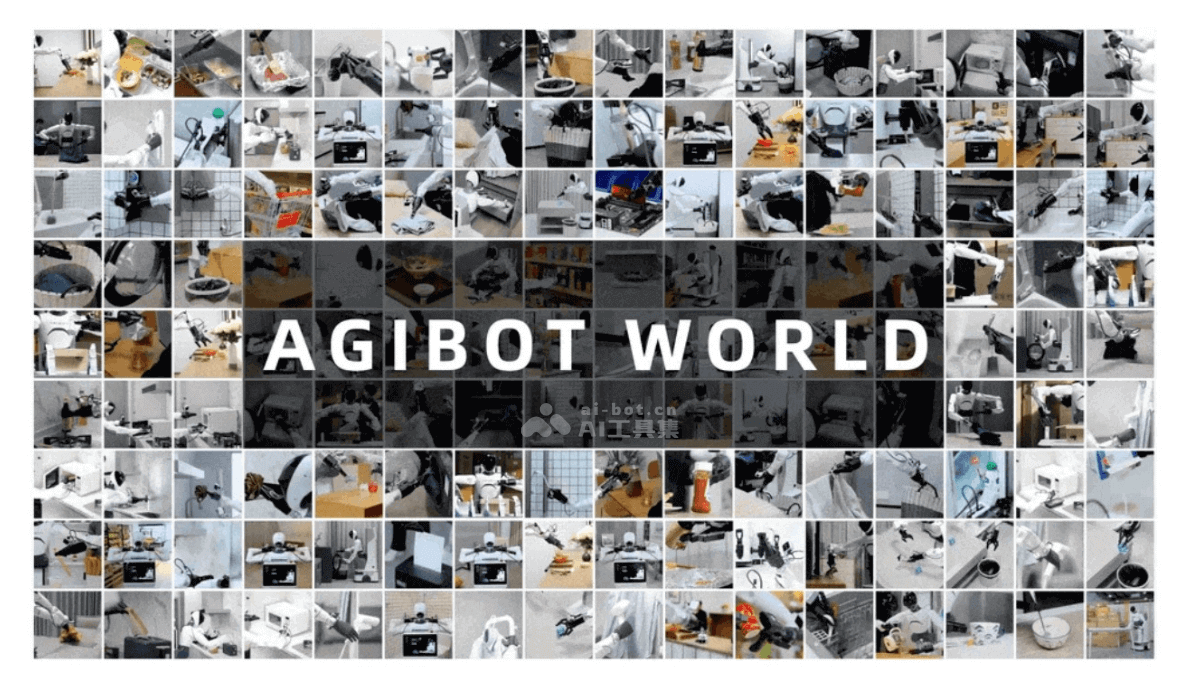
Main Features of AgiBot World
- Diverse Task Coverage: The AgiBot World dataset includes over eighty types of diverse skills in daily life, from basic operations such as grasping, placing, pushing, pulling, to more complex actions such as stirring, folding, ironing, etc., covering almost the vast majority of action requirements needed in daily life.
- All-Domain Real Scenarios: The dataset was born in AgiBot's self-built large-scale data collection factory and application experimental base, with a total spatial area of over 4,000 square meters, containing over three thousand types of real objects, replicating five core scenarios of home, food service, industrial, supermarket, and office, providing a highly realistic production and living environment for robots.
- All-Around Hardware Platform: The robot platform on which the dataset collection relies is equipped with 8 cameras in a surround layout, capable of real-time omnidirectional perception of dynamic changes in the surrounding environment. The robot also has dexterous hands with 6 active degrees of freedom, capable of completing various complex operations such as ironing clothes. With up to 32 degrees of freedom in the whole body, end six-dimensional force sensors, and high-precision visual-tactile sensors, the robot can handle fine operation tasks in an orderly manner.
- Full-Process Quality Control: AgiBot adopted a multi-level quality control and full-process human-in-the-loop strategy during the collection process of AgiBot World, from professional training of collectors, to strict management during collection, to data screening, review, and annotation; every step was carefully designed and strictly controlled.
- Dataset Content: AgiBot World includes over eighty types of diverse skills in daily life, from basic operations such as grasping, placing, pushing, pulling, to complex actions such as stirring, folding, ironing, etc., covering almost the vast majority of action requirements needed in human daily life.
- Open-Source Plan: AgiBot plans to successively open-source tens of millions of simulation data to support more generalized and more universal large model training; will release an embodied foundation large model that can support model fine-tuning; and release a full set of toolchains to achieve a closed loop of collection, training, and evaluation.
Project Address of AgiBot World
- Project Official Website:agibot-world.com
- Github Repository:https://github.com/OpenDriveLab/agibot-world
- HuggingFace Model Library:https://huggingface.co/agibot-world
Application Scenarios of AgiBot World
- Home Scenarios: AgiBot World recreates real human residential layouts, including core spaces such as bedrooms, living rooms, kitchens, and bathrooms. In these scenarios, robots can perform household cleaning, item organization, and kitchen tasks, etc.
- Food Service Scenarios: The dataset includes food service-related tasks, such as stirring and folding actions in the kitchen, as well as possible restaurant service tasks.
- Industrial Scenarios: Simulates sorting and logistics automation, replicating industrial warehouses and production lines, including sorting systems, packaging equipment, conveyor belts, etc. This helps train robots to achieve tasks such as material sorting, packaging, and logistics handling.
- Supermarket Scenarios: Highly faithful reproduction of supermarket shelf layouts and checkout area designs, including multiple category areas such as fresh produce, daily necessities, and frozen goods. This helps train robots to simulate item stocking, inventory counting, customer guidance, unmanned checkout, and more.
- Office scenario: Covers tasks that robots may need to perform in an office environment, such as document organization, item delivery, and more.