
What Is AgentSociety
AgentSociety is a social simulator launched by Tsinghua University based on large language models (LLMs), simulating complex social behaviors and phenomena by building agents with a "human-like mind." By combining sociological theories, it endows agents with emotions, needs, and cognitive abilities, enabling them to move, work, consume, and engage in social interactions in a simulated urban environment. AgentSociety's core functions include realistic urban social environment simulation, a large-scale social simulation engine, and an intelligent social science research toolbox. It can be used to analyze social phenomena and serves as an experimental platform for policy sandbox testing, crisis early warning, and exploration of future social forms.
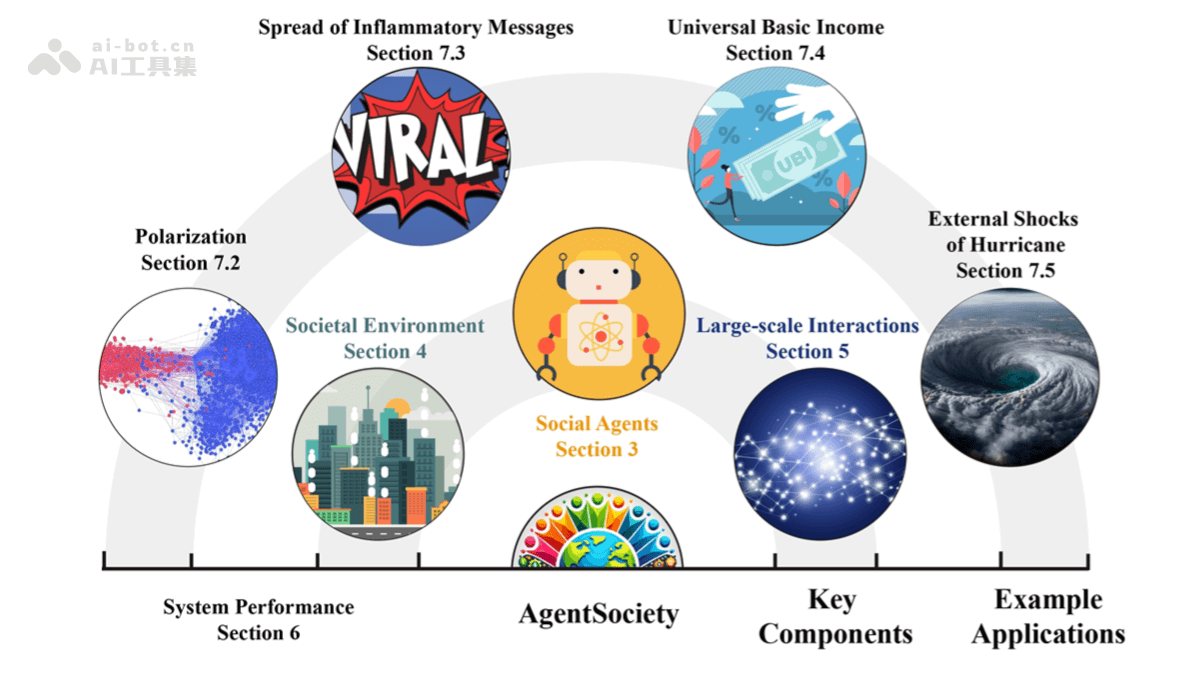
AgentSociety's Main Features
- LLM-Driven Social Human Agents: AgentSociety builds agents with a "human-like mind," endowing them with emotions, needs, motivations, and cognitive abilities, enabling them to move, work, consume, and engage in social interactions in complex social environments.
- Realistic Urban Social Environment Simulation: The platform can accurately simulate urban space, including transportation, infrastructure, and public resources, ensuring that agents interact under real environmental constraints and form a realistic social ecosystem.
- Large-Scale Social Simulation Engine: It adopts an asynchronous simulation architecture and the Ray distributed computing framework, combined with MQTT high-concurrency communication, to achieve efficient and scalable agent interaction and behavior simulation.
- Intelligent Social Science Research Toolbox: It provides tools that comprehensively support sociological research methods such as experiments, interviews, and questionnaire surveys, as well as a variety of automated data analysis tools, facilitating social science research from qualitative to quantitative.
- Real-Time Interactive Visualization: It provides a real-time interface to facilitate researchers in monitoring and interacting with agents during experiments.
AgentSociety's Technical Principles
- Mind Level: Agents are endowed with stable individual profiles (such as personality, age, and gender) and dynamic personal states (such as emotions, economic status, and social relationships), ensuring the personalization of their behavioral patterns.
- Mind-Behavior Coupling: Agent behavior is jointly driven by their emotions, needs, and cognition. Based on Maslow's hierarchy of needs theory and the theory of planned behavior, it realizes a complete path from psychological states to behavioral execution.
- Behavior Level: Agents can perform simple behaviors (such as sleeping and eating) and complex social behaviors (such as mobility, socializing, and economic activities), and dynamically adjust their behavior according to environmental feedback.
- Urban Space: It simulates urban road networks, areas of interest (AOI), and points of interest (POI), and supports multiple modes of transportation (such as walking, driving, and public transit).
- Social Space: It supports online and offline social interactions and simulates the dynamic changes of social networks.
- Economic Space: It simulates macroeconomic activities, including employment, consumption, taxation, and interest mechanisms, and supports the simulation of economic behavior.
- Asynchronous Simulation Architecture: Each agent acts as an independent simulation unit and exchanges information through a messaging system, avoiding the strict execution order in traditional multi-agent systems.
- Distributed Computing: Based on the Ray framework and Python's asyncio mechanism, it achieves efficient utilization of multi-core computing resources and supports distributed cluster scaling.
- MQTT Communication Protocol: Supports high-concurrency, low-latency message transmission among large-scale agents, ensuring the real-time performance and reliability of the simulation.
AgentSociety's project address
- Project official website:https://agentsociety.readthedocs.io/en/latest/
- Github repository:https://github.com/tsinghua-fib-lab/agentsociety/
- arXiv technical paper:https://arxiv.org/pdf/2502.08691
Application scenarios of AgentSociety
- Public opinion dissemination: Simulate the propagation paths and impact of information in social networks.
- Public policy response: Evaluate the impact of policies on individual and group behavior.
- Social polarization: Study the mechanisms of opinion differentiation and the formation of opposing camps.
- Natural disaster response: Simulate crowd behavior and social dynamics under extreme events.