
What Is AgentScope Java
AgentScope Java is an open-source Java framework from Alibaba for enterprise-grade agent development, enabling Java developers to easily build production-grade AI applications. The framework adopts the leading ReAct paradigm, giving large models autonomous reasoning and planning capabilities, while providing comprehensive runtime control mechanisms to ensure a balance between autonomy and controllability. Leveraging the advantages of the Java ecosystem, the framework deeply integrates with enterprises' existing technology stacks, supports one-click deployment to cloud platforms, and comes with a complete toolchain including visual debugging, A/B testing, and reinforcement learning, helping developers build stable, reliable, and continuously evolving agent applications.
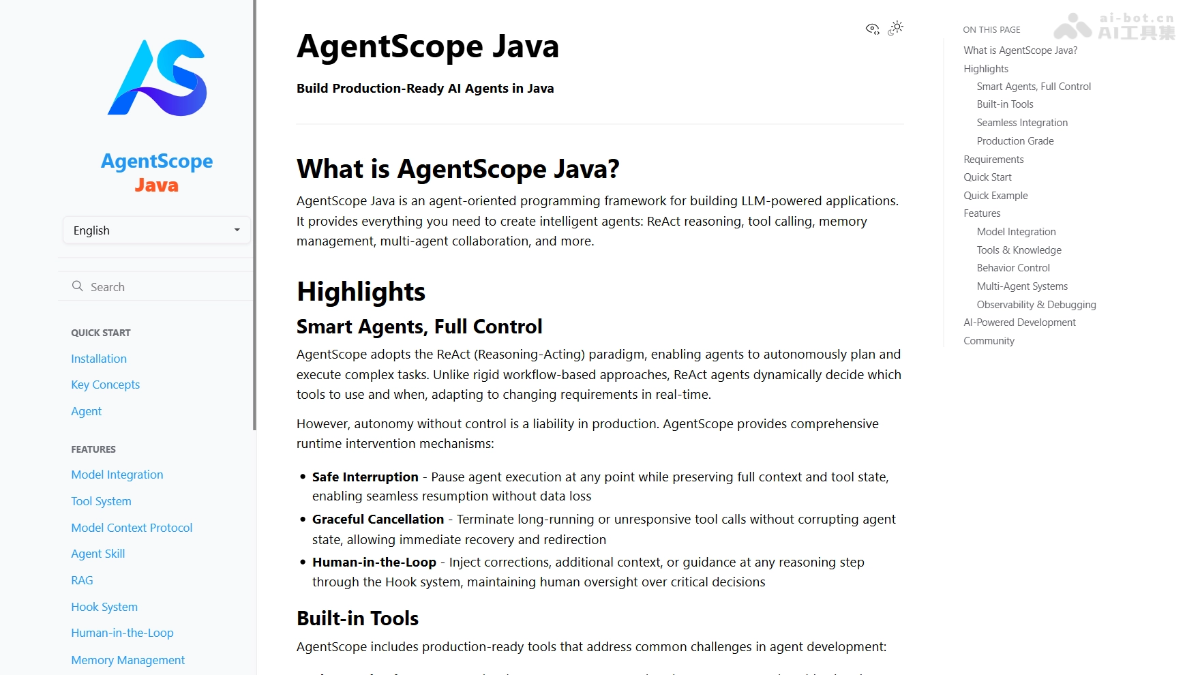
AgentScope Java's Main Features
- ReAct Agent Paradigm: Empowers large models with autonomous reasoning and dynamic planning capabilities, enabling them to flexibly invoke tools to accomplish complex goals based on task requirements.
- Real-Time Intervention Control: Supports safe interruption, real-time interruption, and flexible customization, allowing developers to stay in control throughout the Agent's operation and avoid resource waste.
- Efficient Tool System: Provides standardized registration interfaces, structured tool groups, and dynamic management of meta-tools, uniformly handling synchronous and asynchronous calls and supporting parallel execution.
- Structured Output Assurance: Ensures through built-in tools that LLM output strictly follows a predefined JSON format, automatically corrects errors, and directly maps to Java objects.
- Enterprise-Grade Secure Sandbox: Provides a highly isolated controlled environment for code execution, with built-in sandbox support for multiple platforms including GUI, file systems, and mobile.
- Context Engineering Optimization: Integrates RAG retrieval-augmented generation and multi-tenant memory management, supports private deployment and semantic search, and delivers an experience that gets smarter with use.
- Seamless Protocol Integration: Integrates existing HTTP business systems with zero changes through the MCP protocol, and enables distributed multi-Agent collaboration like microservices through the A2A protocol.
- High-Performance Asynchronous Architecture: Implements non-blocking execution based on Project Reactor, and together with GraalVM achieves 200-millisecond cold starts, adapting to Serverless elastic scenarios.
- Full-Chain Observability: Deeply integrates OpenTelemetry for end-to-end tracing, and works with the Studio visualization platform to provide real-time debugging and monitoring capabilities.
- Data Flywheel Ecosystem: Forms a closed loop through A/B testing, reward model evaluation, and reinforcement learning training, continuously collecting online data to optimize model capabilities.
AgentScope Java's Technical Principles
- Asynchronous Reactive Architecture: The framework builds a fully asynchronous non-blocking execution engine based on Project Reactor. All model calls, tool executions, and message passing are handled as Mono/Flux streams, achieving efficient resource utilization under high concurrency through an event loop mechanism and avoiding thread blocking due to waiting for I/O.
- ReAct Reasoning Engine: The framework's core adopts a reasoning-acting loop mechanism. In each iteration, the LLM generates a structured thought process and autonomously decides the next operation. The engine parses the action instructions output by the model, schedules the corresponding tool for execution, and feeds the results back into the context, forming a closed-loop reasoning chain until the task is completed.
- Context State Machine: The framework can maintain a fine-grained dialogue state tree, supporting multi-branch plan management and checkpoint persistence. Through a hierarchical memory architecture, it separates short-term dialogue history from long-term semantic memory, and uses vector retrieval to achieve cross-session knowledge recall, ensuring coherence over long-range dependencies.
- Tool Invocation Bus: The framework designs a unified tool abstraction layer, automatically extracting function signatures to generate JSON Schema descriptions. The execution layer encapsulates differences among synchronous, asynchronous, and streaming calls through dynamic proxies, schedules tool tasks in a backpressure-aware manner, and supports parallel execution and timeout circuit breaking.
AgentScope Java project address
- Project official website:https://java.agentscope.io/en/intro.html
- GitHub repository:https://github.com/agentscope-ai/agentscope-java
Application scenarios of AgentScope Java
- Intelligent customer service and marketing: The framework supports building 24/7 online intelligent customer service Agents, combined with a RAG knowledge base to achieve precise question answering, providing personalized recommendations and proactive marketing services to improve customer conversion rates.
- Financial risk control and investment research: Supports the development of real-time risk control Agents to monitor transaction anomalies, and executes quantitative strategy backtesting in a secure sandbox to ensure data isolation and compliance.
- Government affairs and public services: Builds policy consultation Agents connected to privatized knowledge bases, and uses the A2A protocol to coordinate Agents of different departments for cross-system business collaboration, improving the efficiency of government services.
- Enterprise intelligent office: Creates meeting assistant Agents to automatically schedule appointments and generate minutes, and builds data analysis Agents that call BI tools to generate visualized reports.