
What is Agents-A1
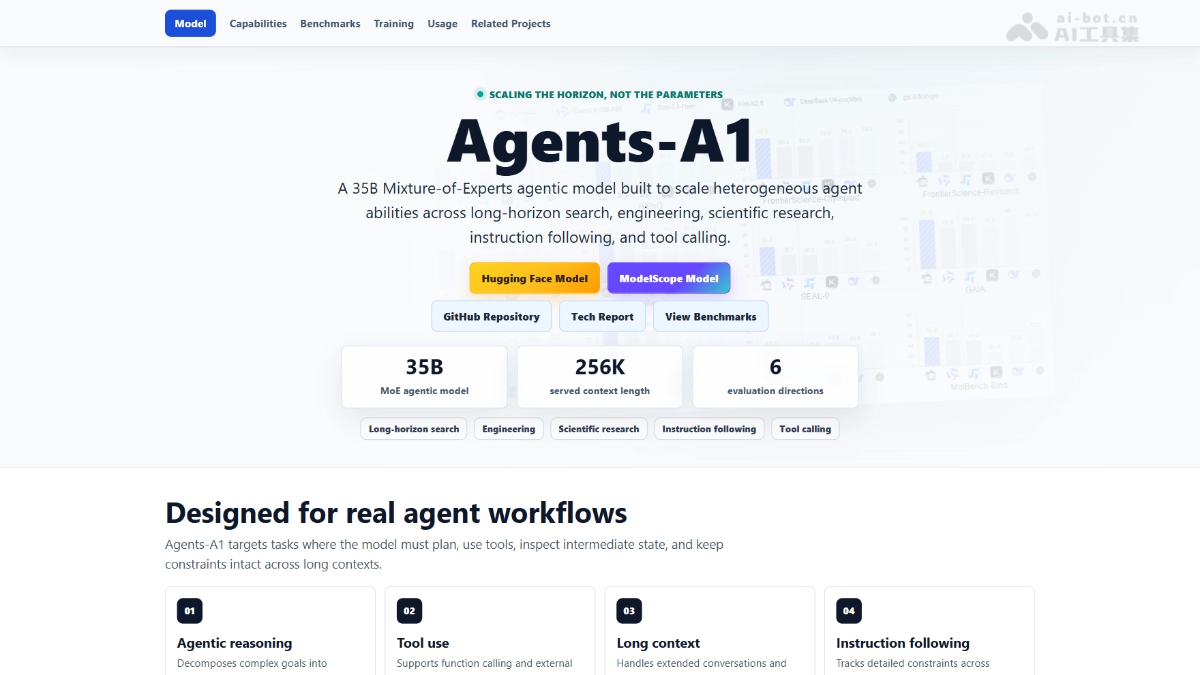
Agents-A1 is a 35B-parameter Mixture-of-Experts (MoE) agent model open-sourced by Shanghai AI Lab, designed specifically for complex scientific research tasks. The model builds verifiable long-trajectory infrastructure through a Knowledge-Action Graph, paired with three-stage multi-expert distillation training, breaking through the limitation of large models relying on massive parameters to achieve complex reasoning. The model performs on par with trillion-parameter models on tasks such as long-horizon search, scientific reasoning, and instruction following.
Agents-A1's Main Features
-
Long-Horizon Autonomous Task Execution: Supports continuous multi-step interaction, environmental feedback, and iterative execution to complete the entire complex scientific research workflow.
-
Scientific Reasoning: Covers multiple stages including idea generation, solution design, code implementation, and experimental validation.
-
Long-Horizon Search: Integrates multi-round information retrieval, cross-validation, and report generation.
-
Tool Calling: Flexibly calls external tools, APIs, and environments for interaction, dynamically adjusting strategies.
-
Instruction Following: Completes reasoning, decision-making, and failure replanning under complex constraints.
Agents-A1's Technical Principles
- Knowledge-Action Graph (KAG): Unlike ordinary knowledge graphs, KAG preserves the complete trajectory of how answers are obtained, examined, corrected, and verified, and continuously expands high-quality long-trajectory data through self-play, with an average length of about 45,000 tokens, providing process-level supervision for the model.
- Three-Stage Training Pipeline: The first stage performs full-domain supervised fine-tuning to acquire general agent foundational capabilities; the second stage trains multiple domain expert models for subdivided tasks, specifically strengthening specialized capabilities such as long-horizon search, scientific reasoning, and tool calling; the third stage unifies different expert capabilities into a single model through multi-domain routed online policy distillation (OPD).
- Salient Vocabulary-Aligned Distillation: Adopts multi-teacher domain-routed online policy distillation, improving cross-domain knowledge transfer efficiency through salient vocabulary alignment, unifying six heterogeneous domains including search, science, engineering, and instruction following into a single deployable student model.

Follow on WeChat and reply "Open Source", join theAI Open Source Project Exchange Group
How to Use Agents-A1
- Environment Preparation: Clone the GitHub code repository and install Python dependencies, ensuring GPU VRAM of no less than 48GB to support 35B MoE model inference.
- Model Acquisition: Download via HuggingFace CLI or ModelScope community command line
InternScience/Agents-A1complete weights and configuration files. - Local Deployment: Use the Transformers library to load the model from a local path, configure
device_map="auto"to achieve multi-GPU parallelism or efficient single-GPU allocation. - Task Execution: After registering external tools such as search APIs and code interpreters in the configuration file, submit scientific research goals in natural language, and the model automatically decomposes steps, calls tools, and iteratively outputs results.
Agents-A1's Core Advantages
-
Small Parameters, Large Capabilities: With only 35B parameters, it matches or surpasses trillion-parameter models on benchmarks such as SEAL-0, IFBench, and HiPhO.
-
Interaction Depth Scaling Law: Shift from horizontal expansion of parameter scale to vertical expansion of interaction depth, leveraging a smaller scale to achieve stronger complex task processing capabilities.
-
General-Specialist Integration: A single model uniformly covers multiple domains such as long-horizon search, scientific reasoning, tool calling, and instruction following.
-
Verifiable Long Trajectories: The KAG mechanism preserves complete action and verification trajectories, ensuring the process is traceable and the results are verifiable.
-
Fully Open Source: Code, models, and technical reports are all open source, with cumulative downloads exceeding 200,000 within 10 days of launch, and community-derived versions continuing to emerge.
Project address of Agents-A1
- Project official website:https://internscience.github.io/Agents-A1/
- GitHub repository:https://github.com/InternScience/Agents-A1
- HuggingFace model library:https://huggingface.co/InternScience/Agents-A1
- arXiv technical paper:https://arxiv.org/pdf/2606.30616
Comparison of Agents-A1 with similar competing products
| Dimension | Agents-A1 | Kimi-K2.6 |
|---|---|---|
| Parameter scale | 35B MoE | ~1T |
| Open source | Yes | No |
| Positioning | Long-horizon scientific research agent | General-purpose dialogue assistant |
| Long-horizon interaction optimization | Core architecture design | Partially supported |
| SEAL-0 | 56.4 | 50.0 |
| IFBench | 80.6 | 71.8 |
| HiPhO | 46.4 | 37.7 |
| FrontierScience-Olympiad | 79.0 | 76.0 |
| Training paradigm | Knowledge-action graph + multi-expert distillation | Traditional pre-training + post-training |
Application scenarios of Agents-A1
-
Automated scientific research: Automates the full-process scientific research workflow covering literature review, experimental design, data analysis, and result verification.
-
Machine learning engineering: Automatically completes complex engineering iterations such as model selection, feature engineering, hyperparameter tuning, and model ensembling.
-
Complex information retrieval: Executes multi-round deep search, cross-validates information, and generates structured research reports.
-
Long-horizon code development: Supports programming, debugging, performance optimization, and automated code review for large projects.
-
Scientific computing: Assists with computation-intensive tasks such as mathematical proofs, chemical molecular simulation, and bioinformatics data analysis.