
What is AgentRefine
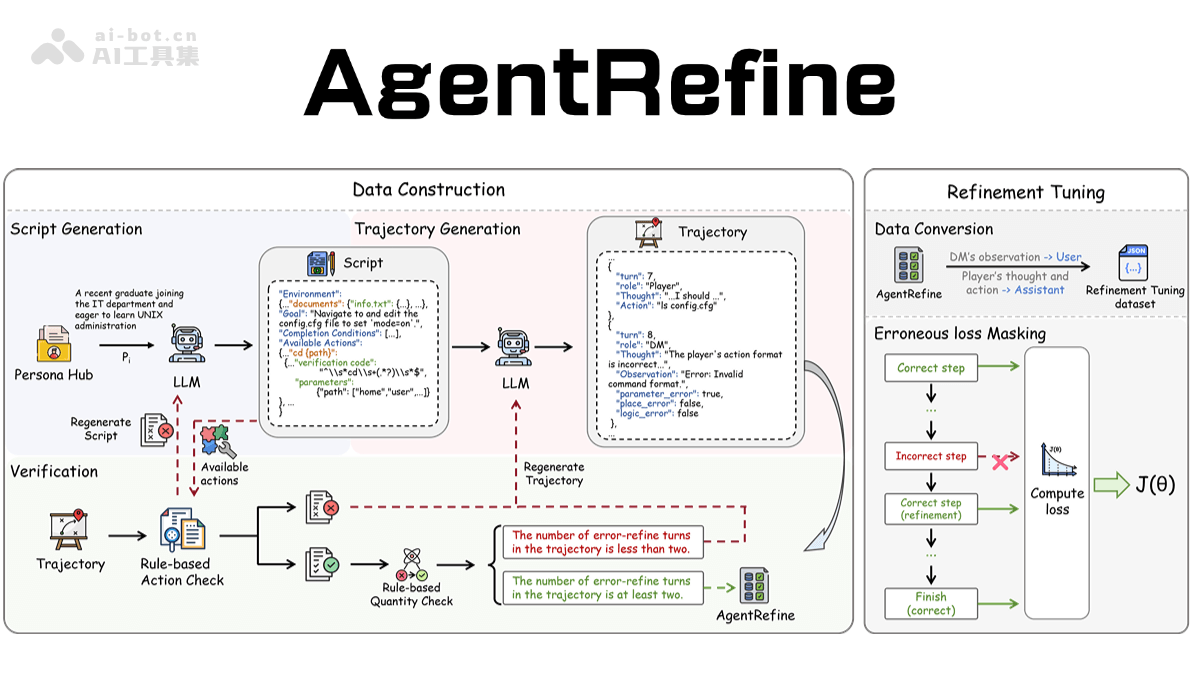
AgentRefine is an intelligent agent synthesis framework jointly proposed by Beijing University of Posts and Telecommunications and Meituan. Through "Refinement Tuning", it improves the generalization ability of intelligent agents based on large language models (LLMs) in diverse tasks. It enables agents to learn to correct errors through observations in trajectories, achieving self-optimization. Inspired by tabletop role-playing games (TRPGs), the research team designed a data construction process comprising script generation, trajectory generation, and verification.
Main features of AgentRefine
- Error correction and self-optimization: AgentRefine enables agents to learn to correct errors through observations in trajectories, achieving self-optimization. The process is similar to human reflection and adjustment when facing errors, allowing agents to better adapt to new environments and tasks.
-
Integration of diverse environments and tasks: The framework integrates multiple environments and tasks, enabling agents to flexibly adjust strategies when facing complex scenarios
-
Enhanced robustness: AgentRefine shows stronger robustness when facing environmental perturbations. For example, when task descriptions or environment settings change slightly, AgentRefine can better adapt and maintain performance.
-
Diversified reasoning process: AgentRefine can generate diverse lines of thought during the reasoning process. Rather than relying on fixed patterns in memory, it can dynamically adjust decision paths based on environmental feedback.
Technical principles of AgentRefine
- Self-refinement capability: The core idea of AgentRefine is to enable agents to learn to correct errors through observations in trajectories. The framework simulates multiple rounds of interaction, allowing the model to self-correct based on environmental feedback after generating erroneous actions. This enables agents to avoid falling into fixed error patterns and discover correct action sequences through reasonable exploration.
- Data synthesis and verification: The framework generates multi-round interaction data and uses a verifier to detect format or logic errors in the generated content. Erroneous interactions are retained, and the model is prompted to correct them based on observation results, ultimately generating self-refined data.
- Robustness and diversified reasoning: AgentRefine shows stronger robustness when facing environmental perturbations. For example, when task descriptions or environment settings change slightly, it can maintain good performance. The framework can generate diverse reasoning paths, further improving the agent's generalization ability.
AgentRefine project address
- Project official website:https://agentrefine.github.io/
- Github repository:https://github.com/Fu-Dayuan/AgentRefine
- arXiv technical paper:https://arxiv.org/pdf/2501.01702
Application scenarios of AgentRefine
- Automated decision-making for complex tasks: AgentRefine can be applied to tasks that require multi-round decision-making in complex environments, such as autonomous driving, robot navigation, and intelligent customer service.
- Game AI and virtual environments: In game AI and virtual environments, AgentRefine can improve the decision quality and diversity of agents through self-optimization.
- Code generation and optimization: In the field of code generation, AgentRefine can generate initial code, identify errors and deficiencies in the code through a self-reflection mechanism, perform iterative optimization, and ultimately generate high-quality code.
- Natural language processing tasks: AgentRefine can be used for text generation and dialogue systems in natural language processing. AgentRefine can generate a first draft and optimize the content through a self-reflection mechanism, improving the quality of the article.
- Scientific research and simulation environments: In scientific research that requires simulating complex environments, AgentRefine can better adapt to dynamically changing environments through self-correction and generalization capabilities.