
What is AgentQL
AgentQL is a web scraping tool based on AI technology that supports users in describing the location and interaction of web elements in natural language, without the need for complex XPath or DOM selectors. AgentQL's semantic selectors can understand the meaning of elements, reliably finding them even when websites change. AgentQL provides controllable output and deterministic results, making data scraping, automation, and end-to-end testing simpler and more efficient.
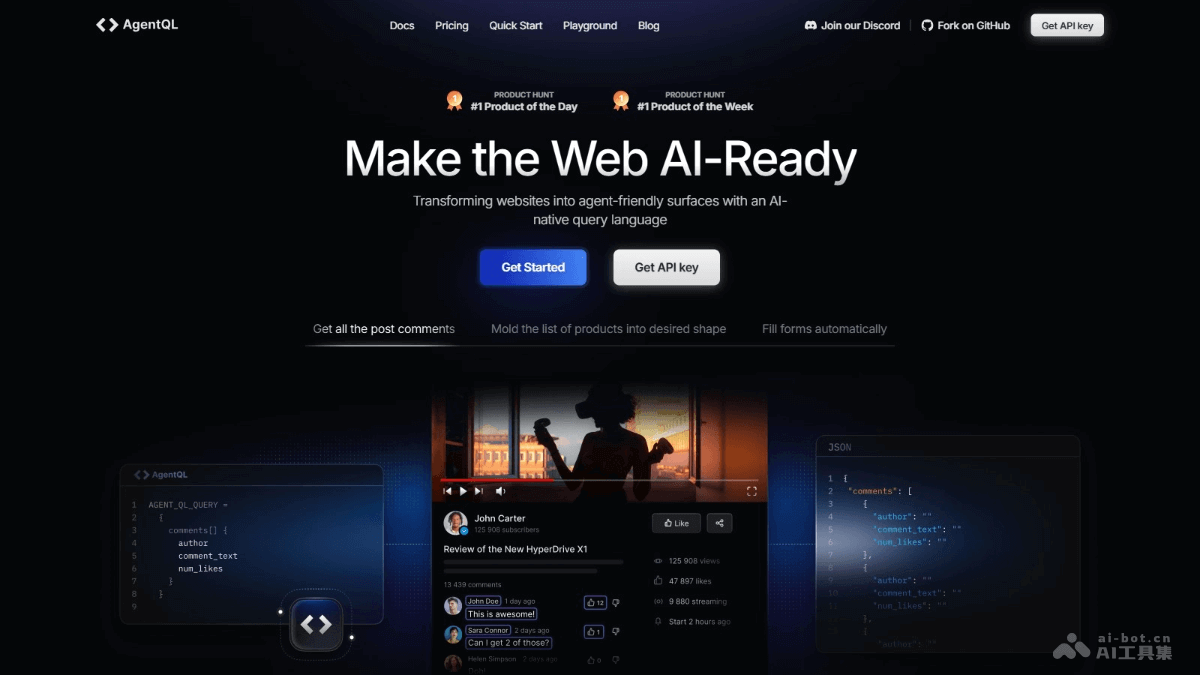
AgentQL's main features
- Natural language queries: Describe the location of web elements in natural language, replacing traditional XPath and DOM selectors.
- Semantic selectors: Locate web elements by their semantic meaning, improving the stability and accuracy of queries.
- Controllable output: Supports users in obtaining results in a precise format, facilitating further processing and analysis of data.
- Chrome extension: Provides a Chrome browser extension, making it convenient for users to directly extract data and interact with web elements in the browser.
- API key management: Based on API key management, ensuring the security of user access while using AgentQL's powerful features.
AgentQL's official website address
- Official website address:agentql.com
AgentQL's product pricing
- Free Trial:300 free API calls per month, 10 API calls per minute
- Starter:50 free API calls per month, 10 API calls per minute
- Professional:$99/month, 10,000 free API calls per month, 50 API calls per minute
- Enterprise Custom:Custom pricing, customized pricing model, no rate limits
AgentQL's application scenarios
- Data scraping: Quickly collect information from websites, such as prices, reviews, product details, etc., for market analysis, competitor analysis, or content aggregation.
- Automated testing: In software development, automated testing of web applications ensures that website functions work as expected, improving testing efficiency and accuracy.
- Web automation: Automatically perform repetitive tasks on web pages, such as filling out forms, clicking buttons, data entry, etc., reducing manual operations and improving work efficiency.
- Information monitoring: Monitor changes in website content, such as news updates, price changes, etc., to obtain the latest information in a timely manner.
- Content aggregation: Aggregate data from multiple sources to create a unified information platform, providing users with one-stop service.