
What Is Agentic Reasoning
Agentic Reasoning is a framework launched by the University of Oxford to enhance the reasoning capabilities of large language models (LLMs). It solves complex multi-step reasoning problems by integrating external tools (such as web search, code execution, and structured memory). The core idea of Agentic Reasoning is to let LLMs dynamically invoke external agents (such as the Mind Map agent, web search agent, and code agent) during the reasoning process, retrieving information in real time, performing computational analysis, and organizing complex logical relationships. The framework performs excellently in doctoral-level scientific reasoning (such as the GPQA dataset) and domain-specific deep research tasks, outperforming existing retrieval-augmented generation (RAG) systems and closed-source LLMs.
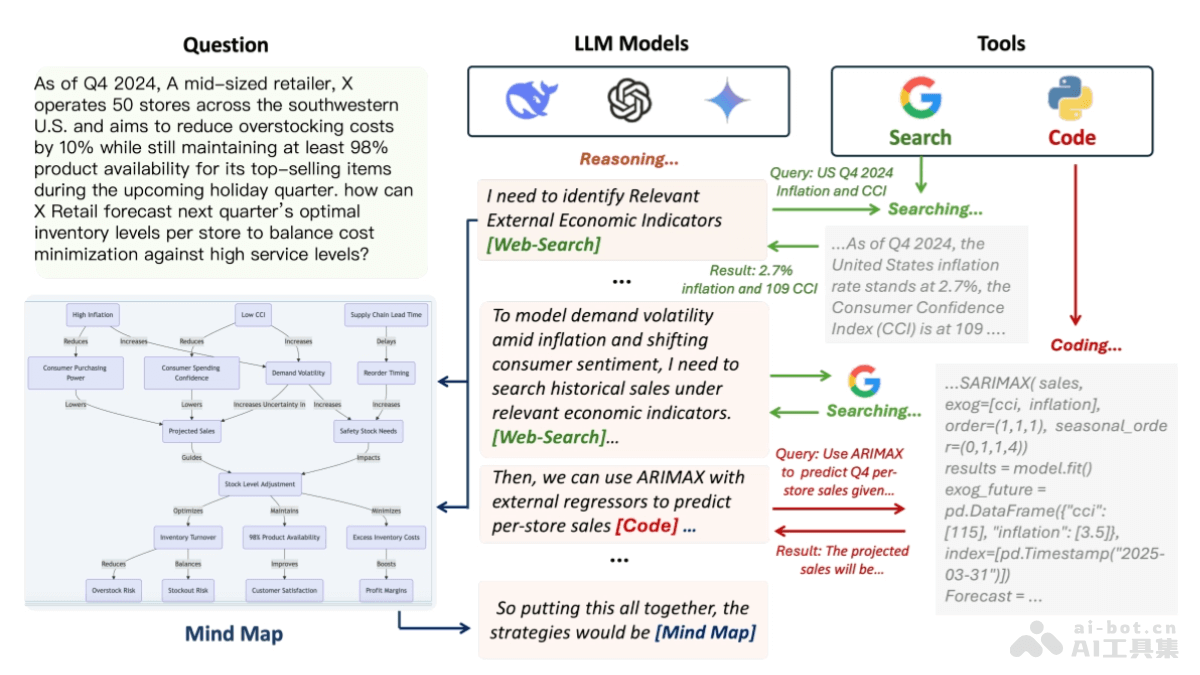
Main Features of Agentic Reasoning
- Enhanced multi-step reasoning capability: With the assistance of external tools (such as web search, code execution, and structured memory), LLMs can more efficiently handle complex problems that require deep research and multi-step logical deduction.
- Real-time information retrieval and updating: Use the web search agent to obtain the latest information in real time, ensuring the accuracy and timeliness of knowledge during the reasoning process.
- Organization of complex logical relationships: Build a knowledge graph based on the Mind Map agent to help LLMs clearly organize and track logical relationships during the reasoning process, improving deductive reasoning capabilities.
- Computational analysis support: With the help of the code agent, execute programming tasks to provide precise computational results for problems that require quantitative analysis.
- Improved reasoning efficiency and accuracy: Through task allocation and tool invocation, reduce the burden on the main reasoning model and avoid interrupting the reasoning chain due to handling auxiliary tasks.
- Expert-level knowledge synthesis: In deep research tasks, generate high-quality analysis reports that reach or even exceed the level of human experts.
Technical Principles of Agentic Reasoning
- Dynamic tool invocation mechanism: During the reasoning process, the LLM decides in real time whether to invoke external tools (such as web search or code execution) according to the current reasoning needs. When external information is needed, the LLM generates a specific query request and embeds a special marker (such as a "search" or "code" marker), pauses reasoning, and sends the request to the corresponding agent.
- Collaborative work of external agents:
- Mind Map agent: Transform the reasoning chain into a structured knowledge graph, providing logical support for reasoning based on entity recognition and semantic relationship extraction. The knowledge graph can be queried to help the LLM quickly obtain relevant information during the reasoning process.
- Web search agent: Retrieve documents related to the reasoning context from the internet, extract key information based on the LLM, and generate concise summaries to ensure the relevance and logical coherence of the information.
- Code agent: Receive code requests from the LLM, write and execute code, and return the results. This avoids the complexity of the LLM directly generating and executing code and improves reasoning efficiency.
- Iterative reasoning and knowledge updating: The reasoning process is an iterative loop. The LLM updates the reasoning chain based on the results returned by external agents, gradually refining the logical deduction until the final answer is reached.
- Probability-based generative model: The generation of the reasoning chain and the final answer is based on a joint probability model, combining task instructions, queries, tool outputs, and the knowledge graph to dynamically generate a coherent reasoning process and accurate answers.
- Reasoning Optimization and Verification: Optimize the reasoning process based on metrics such as tool invocation frequency, select the best reasoning path, and improve the accuracy and efficiency of reasoning.
Agentic Reasoning's project address
- GitHub repository:https://github.com/theworldofagents/Agentic-Reasoning
- arXiv technical paper:https://arxiv.org/pdf/2502.04644
Application scenarios of Agentic Reasoning
- Academic research and complex problem solving: Based on multi-step reasoning and tool invocation, solve doctoral-level scientific problems and provide high-precision answers.
- Medical decision support: Combine web search and code execution to provide accurate diagnosis and treatment plan support for medical scenarios.
- Financial and legal research: Quickly retrieve regulations and data, generate high-quality research reports, and assist professional decision-making.
- Complex logic games and strategy optimization: In games such as Werewolf, achieve high win-rate strategies based on logical reasoning and relationship tracking.
- Cross-domain in-depth research: Integrate information from multiple domains, generate comprehensive reports, and facilitate knowledge synthesis and analysis for complex problems.