
What is Agentic Object Detection
Agentic Object Detection is a new type of object detection technology developed by Andrew Ng's team. It uses an intelligent agent system to achieve object detection without annotated data. Users only need to input text prompts, and the AI uses reasoning capabilities to identify targets in images and precisely locate their positions and attributes. It does not require the large amount of annotated data and complex training process needed by traditional object detection, reducing development and application costs. It can perform precise recognition based on the intrinsic attributes of targets (such as color and shape), contextual relationships (such as spatial position), and dynamic states (such as action changes), making it suitable for a variety of complex scenarios.
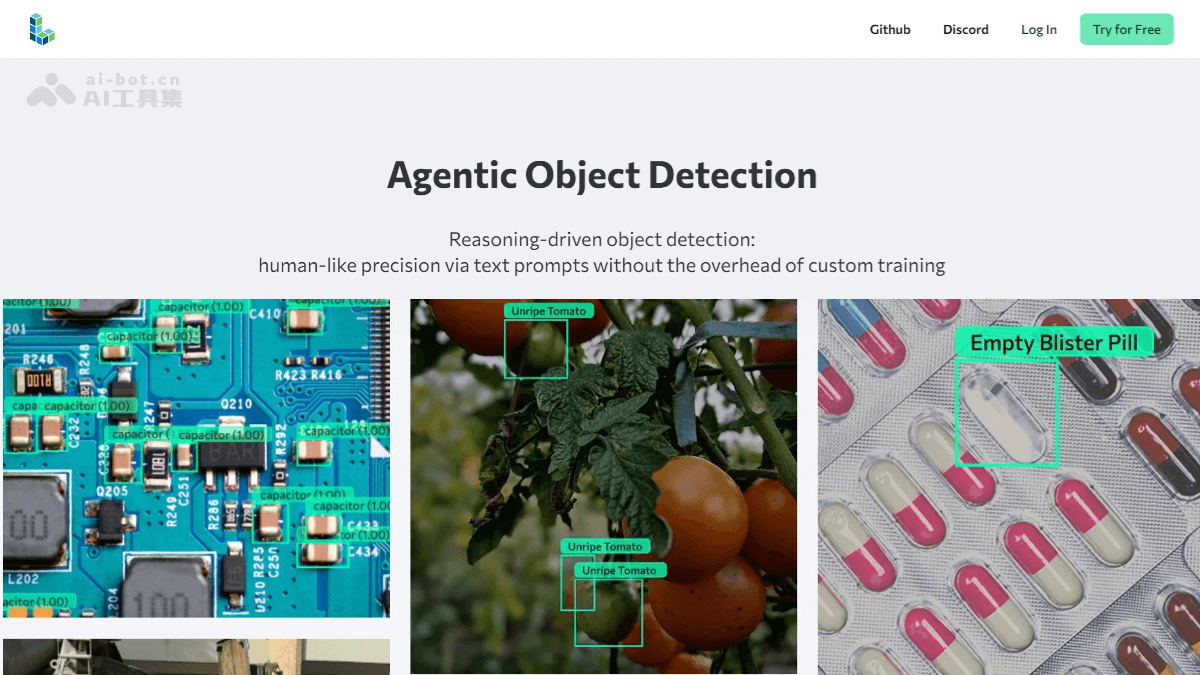
Main features of Agentic Object Detection
- Zero-shot labeling detection: Without any annotated data or model training, target objects can be located and identified in images through text prompts.
- Intrinsic attribute recognition: Recognition based on the inherent attributes of targets, for example identifying "unripe strawberries".
- Contextual relationship recognition: Recognition of targets based on their spatial position or relationship with other objects, for example identifying "a daisy on ice cream".
- Specific target recognition: Precisely distinguishing specific objects within the same category to ensure accurate recognition.
- Dynamic state detection: Recognition based on the movement, action, or state changes of targets.
Technical principles of Agentic Object Detection
- Intelligent agent system and design patterns: Agentic Object Detection uses an intelligent agent system, combined with design patterns, to perform deep reasoning about the unique attributes of targets (such as color, shape, texture, etc.). It can help AI understand the inherent attributes and contextual relationships of targets, enabling more precise recognition.
- Zero-shot labeling and reasoning: It achieves zero-shot detection through reasoning, without any annotated data. The AI can locate targets in images through text prompts provided by users (such as "unripe strawberries").
- Reasoning process: During the detection process, the AI "takes a glance" at the image and then completes the task through a series of reasoning steps (including perception, planning, and action). Although each detection requires about 20-30 seconds of reasoning time, the accuracy is significantly better than traditional methods.
- Multimodal reasoning capability: Agentic Object Detection can understand complex semantic information, such as the state of objects (ripe/unripe), brand characteristics, and other detailed attributes.
Project address of Agentic Object Detection
- Project official website:anding.ai/agentic-object-detection
Application scenarios of Agentic Object Detection
- Assembly verification: It can identify whether capacitors are correctly installed, ensuring the accuracy of the production process and product quality.
- Crop detection: It accurately identifies crops such as unripe tomatoes, making it convenient for farmers to take timely measures and improve yield and quality.
- Medical imaging analysis: It identifies abnormalities in medical images, such as negative antigen test results, assisting doctors in diagnosis.
- Dangerous object detection: It identifies potential dangerous objects or abnormal behavior, improving public safety.
- Product management: It identifies foods of specific brands, such as Rice Krispies Cereal, facilitating inventory management and product display.