
What is AgentGen
AgentGen is an AI project framework jointly launched by the University of Hong Kong and Microsoft. By automatically generating diverse environments and tasks, it significantly improves the planning capabilities of large language models (LLMs). AgentGen uses the BI-EVOL method to create task sets of increasing difficulty, enabling the 8B-parameter Llama-3 model to approach GPT-4 level on certain tasks. AgentGen performs well in both in-domain and out-of-domain task evaluations, and is expected in the future to be applied to complex planning tasks such as robot control and smart homes.
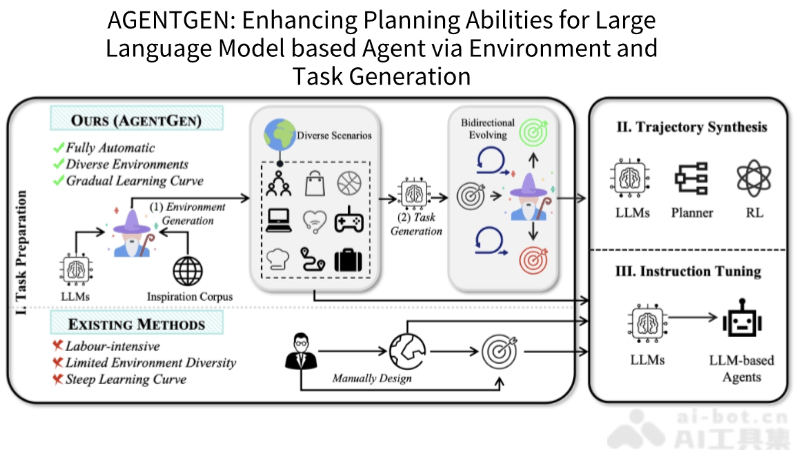
AgentGen's main features
- Adaptive environment construction: The framework can independently conceive and create diverse virtual environments, providing agents with rich interactive scenarios.
- Intelligent task customization: Based on advanced language models, AgentGen can intelligently customize tasks, and the generated environments can be adaptive.
- Dynamic difficulty adjustment: Through the innovative BI-EVOL strategy, the framework can dynamically adjust task difficulty, promoting agents to learn and grow in tasks of different complexity.
- No need for large amounts of training data: AgentGen's zero-shot generation capability reduces the need for large-scale training datasets and accelerates the model training process.
- Precise skill reinforcement: Through instruction fine-tuning, the framework can precisely strengthen an agent's skills on specific tasks and improve its problem-solving ability.
- Comprehensive performance monitoring: Through a detailed performance evaluation system, AgentGen enables agents to achieve optimal performance across various tasks.
AgentGen's technical principles
- Environment generation: AgentGen uses large language models (LLMs) to generate environment specifications, including the definitions of the state space, action space, and transition function. Then, through code generation techniques, it implements the specific code for these environments.
- Heuristic rules and corpora: During environment generation, AgentGen uses heuristic rules and diverse corpora to guide the LLM in generating diverse environments.
- Task generation: Based on the generated environments, AgentGen further uses the LLM to generate corresponding planning tasks, ensuring that the tasks match the environments.
- BI-EVOL method: AgentGen adopts the bidirectional evolution (BI-EVOL) method to adjust task difficulty, including easy-evol (simplifying tasks) and hard-evol (complicating tasks), forming task sets of increasing difficulty.
- Zero-shot learning: In the initial stage of task generation, AgentGen prompts the LLM through zero-shot learning to generate a set of initial planning tasks.
- Instruction fine-tuning: Through instruction fine-tuning techniques, AgentGen fine-tunes the LLM using synthesized trajectory data (sequences of action-observation pairs) to improve its planning ability.
- Performance evaluation: AgentGen evaluates the model's performance on planning tasks through metrics such as success rate and progress rate, ensuring the effectiveness of training.
AgentGen's project address
-
GitHubRepository:https://github.com/soarllm/agentgen
-
arXivTechnical paper:https://arxiv.org/pdf/2408.00764
AgentGen's application scenarios
- Robot control: In the fields of automation and smart manufacturing, AgentGen can be used to improve robots' autonomous planning and decision-making capabilities, enabling them to perform complex tasks more effectively.
- Smart home systems: AgentGen can be integrated into smart home systems, helping the system automatically adjust device settings based on user behavior and preferences, improving living comfort and energy efficiency.
- Personal Assistant: As a personal assistant, AgentGen can help users with scheduling, task planning, and reminders, improving efficiency in life and work.
- Traffic Planning: AgentGen can be used to optimize transportation systems, helping plan more reasonable driving routes, reduce congestion, and improve travel efficiency.
- Game AI: In video game development, AgentGen can be used to generate smarter non-player characters (NPCs), providing a richer gaming experience.