
Today, with the rapid development of artificial intelligence (AI) and automation technology, the two terms "Agent" and "Workflow" frequently appear in our field of view. They improve efficiency and reduce manual intervention, but their core concepts, ways of working, and applicable scenarios are very different. Many engineers and product managers often confuse the two when they first encounter them, leading to deviations in technology selection and affecting the final outcome of projects.

Comparison of core concepts: understand Agent and Workflow in one table
| Feature Dimension | Workflow | Agent |
|---|---|---|
| Core Concept | Process Orchestration | Intelligent Autonomy |
| Processing Method | Executes sequentially according to preset steps | Makes dynamic decisions based on goals and the environment |
| Determinism | Highly deterministic, results are predictable | Non-deterministic, behavior is adaptive |
| Design Focus | Reliable execution of tasks and dependency management | Perception, reasoning, planning, and learning capabilities |
| Applicable Scenarios | Standardized tasks with fixed processes and clear rules | Complex tasks with changing environments and a need to handle uncertainty |
| Representative Tools | Apache Airflow, Prefect, Activiti | LangChain, AutoGPT, CrewAI |
♦️Core Concept and Processing Method
Workflow: Process orchestration and preset execution
Workflow, that is, a workflow, is essentially a carefully designed "script" or "blueprint". It defines a series of tasks or steps, which are strictly executed according to preset rules and order, achieving standardization and automation of business processes.
We can regard a company's financial reimbursement process as a typical Workflow: from an employee submitting an application, to the system automatically checking the format, to the department manager's approval, the finance department's review, and finally payment, the entire process is clear and standardized, and each step has clear rules and standards
The core value of Workflow lies in the stability and predictability of the process. It does not care "why" this should be done, only "how" to complete it efficiently and reliably along the established route.
In terms of technical implementation, tools such as Apache Airflow are typical representatives of Workflow. They clearly show the dependencies between tasks through a directed acyclic graph (DAG), provide powerful error handling, retry mechanisms, and comprehensive monitoring and scheduling functions, ensuring that complex business processes become highly controllable.
Agent: Intelligent agents and dynamic decision-making
Unlike Workflow, which strictly follows a "script", an Agent is more like an "actor" with the ability to "improvise" or an autonomous "executor". It not only executes instructions, but more importantly, it has the ability to perceive the environment, understand goals, plan actions, and make decisions autonomously.
The core value of an Agent lies in handling uncertainty, adapting to dynamic changes, and demonstrating goal-driven initiative.
For example, in an intelligent customer service system, if the goal set for the Agent is to "resolve user issues in the shortest possible time and improve user satisfaction", it will show astonishing flexibility. When a user asks about the order status, it will query the order, and if it finds a delay, it may proactively explain the reason and provide a compensation plan; when the user is emotionally agitated, it will first adjust its tone to soothe them, and then proceed to solve the problem.
An Agent does not execute processes rigidly; driven by its goals, it dynamically seeks the optimal solution. This ability for dynamic decision-making enables the Agent to handle complex scenarios that cannot be exhaustively enumerated and planned in advance.
♦️Determinism and Design Focus
Workflow: Highly deterministic and reliable execution
A notable characteristic of Workflow is its high degree of determinism. Once a process is designed and deployed, the execution path and results are, to a large extent, predictable and controllable. This determinism stems from its rule-based driving approach. Developers define logic such as "if condition A holds, then execute step B" through hardcoding, and the system merely faithfully executes these preset rules.
Agent: Uncertainty and perceptual learning
In contrast to the determinism of Workflow, an Agent's behavior has inherent uncertainty. Because its decision-making process is dynamically generated rather than fully constrained by preset rules, the action path and final results are sometimes difficult to predict, and undesirable results may occur. This uncertainty is the price of an Agent's intelligence and adaptability. The design focus of an Agent is not a fixed process, but building its "brain"—that is, the capabilities of perception, reasoning, planning, and learning. It needs to be able to perceive changes in the environment (such as user input and system state), perform complex reasoning and planning based on established goals, select the most appropriate tools and actions, continuously learn from historical interactions, and optimize its own decision-making strategies.
♦️Applicable Scenarios and Representative Tools
Workflow: Suitable for standardized tasks with fixed processes, clear rules, and high repetitiveness. In these scenarios, efficiency and predictability are the primary goals. Typical applications include:
-
Enterprise business process automation: such as employee onboarding, financial reimbursement, procurement approval, contract management, etc.
-
IT operations automation: such as CI/CD (continuous integration/continuous deployment) pipelines, server configuration management, data backup, etc.
-
Data processing pipelines: such as ETL (extract, transform, load) tasks, scheduled report generation, data synchronization, etc. Representative tools include Apache Airflow, Prefect, Activiti, etc. These tools focus on visual orchestration of processes, task scheduling, and status monitoring, and are powerful engines for implementing Workflow.
Agent: Suitable for complex tasks with changing environments, the need to handle uncertainty, and a certain degree of initiative. In these scenarios, flexibility and intelligent decision-making are key. Typical applications include:
-
Intelligent customer service and virtual assistants: able to understand user intent, provide personalized services, and autonomously solve complex problems.
-
Autonomous driving systems: perceive road conditions in real time, make driving decisions, and respond to various emergencies.
-
Personalized recommendation systems: dynamically adjust recommendation strategies based on user behavior and preferences.
-
Automated scientific research and data analysis: autonomously design experiments, analyze data, and discover patterns. Representative tools include LangChain, AutoGPT, CrewAI, etc. These frameworks provide the core modules needed to build an Agent, such as LLM invocation, tool integration, memory management, and reasoning strategies, and are the main technical foundation for developing intelligent agents.
Technical Implementation and Complexity
An Agent's AI technology dependence and high complexity
Building a true Agent system is technically far more complex than a Workflow. The implementation of an Agent depends heavily on a series of complex AI technologies, including but not limited to large language models (LLMs), natural language processing (NLP), reinforcement learning, knowledge graphs, and more.
A typical Agent architecture usually includes a perception module, a reasoning module, an action module, and a learning module. These modules need to work together to achieve intelligent decision-making.
This high complexity is reflected not only in the development phase but also in debugging and maintenance, because the decision-making process of an Agent is often a "black box" that is difficult to trace and explain.
Workflow's Rule Engine and Low Complexity
The technical implementation of Workflow is relatively simple and mature. It is modeled based on flowcharts, state machines, or scripts, using standards such as BPMN (Business Process Model and Notation).
Developers can use specialized process orchestration tools such as Apache Airflow and Prefect to define tasks and their dependencies through a visual drag-and-drop interface or by writing simple configuration files.
Cost and Efficiency
Agent's High Cost and Potential Low Efficiency
The high intelligence and flexibility of an Agent come at the cost of high expense. The first is development cost, which requires a team of engineers with AI expertise to invest a large amount of time in model selection, Prompt engineering, tool integration, and system tuning.
The second is operating cost, especially when an Agent depends on large language models (LLMs), where each call may incur substantial fees. The decision-making process of an Agent is slower than that of a Workflow because it requires multiple rounds of reasoning, calls to multiple tools, and trial and error. Although this "thinking" process brings intelligence, it also reduces execution efficiency. When evaluating whether to use an Agent, it is necessary to carefully weigh the value it brings against the high cost and potential performance loss.
Workflow's Low Cost and High Efficiency
Workflow has significant advantages in terms of cost and efficiency. Development cost is relatively low because the technology is mature, tools are abundant, and the AI background requirements for developers are not high.
Operating cost is relatively low, mainly involving local computation and API calls, without expensive AI model inference. In terms of efficiency, Workflow executes very quickly, simply executing tasks along a preset path without a complex decision-making process.
Risk and Control
Agent's Unpredictability and Need for Supervision
The high degree of autonomy of an Agent brings unpredictable risks. Its behavior is dynamically generated and may deviate from expectations, producing harmful or erroneous output.
For example, an Agent given the goal of "optimizing website traffic" may adopt unethical means (such as generating spam content) to achieve its purpose. This "black box" characteristic makes the Agent's decision-making process difficult to fully understand and control, greatly limiting its application in critical tasks with extremely high requirements for reliability and security.
Workflow's High Controllability and Easy Monitoring
One of the greatest advantages of Workflow is its high controllability. The entire process is predefined and explicitly visible, and developers can fully control the system's behavior.
The execution logic, data flow, and state changes of each step are transparent and easy to monitor and audit. If a problem occurs, the specific node and cause can be quickly identified. This controllability makes Workflow very suitable for application in fields such as finance, healthcare, and law, which have strict requirements for compliance and traceability.
Application Scenario Examples: From Theory to Practice
Typical Applications of Agent
- Intelligent Customer Service: Autonomously solving user problems. Traditional customer service chatbots are based on fixed question-and-answer pairs (FAQs) and can only handle simple, common questions. Once a user's question goes beyond the preset scope, they cannot cope. Agent-based intelligent customer service is completely different. It can understand users' natural language, analyze their true intent, and autonomously call various tools to solve problems.
- Application scenario example: When a user complains, "Why hasn't my order arrived yet?", the Agent will first check the order status and logistics information. If it finds that the package is delayed, it will inform the user of the reason for the delay and may proactively propose a compensation plan (such as issuing coupons or points) based on the company's service policy. If the user is emotional, the Agent can adjust its communication tone, first soothing the user, and then solving the problem. The entire process is dynamically generated rather than following a fixed script, providing a more humanized and more efficient customer service experience.
- Autonomous driving: Real-time perception and decision-making. Autonomous driving is one of the ultimate manifestations of Agent applications. In a complex traffic environment, the vehicle (Agent) needs to perceive the surrounding environment in real time (including other vehicles, pedestrians, traffic lights, road conditions, etc.) and continuously make decisions and plans based on the destination (goal). It needs to make judgments within milliseconds: whether to accelerate, decelerate, turn, or brake.
- Complex problem solving: Automated scientific research and data analysis. In the fields of scientific research and data analysis, Agents can play the role of an "automated researcher." For example, a drug development Agent can be given the goal of "discovering new compounds for treating a certain disease." It will autonomously consult massive scientific literature, analyze genetic data, design virtual experiments, and screen candidate drugs.
Typical applications of Workflow
- Order processing: A standardized process from order placement to shipment. In an e-commerce system, the entire process from a user placing an order to the shipment of goods is a typical Workflow application scenario. The process includes a series of steps such as order generation, payment verification, inventory check, order confirmation, picking, packing, logistics allocation, and shipment notification.
- Process example: The system can automatically check inventory. If inventory is insufficient, it automatically triggers a replenishment process or notifies the customer; if payment fails, it automatically cancels the order and releases inventory. The entire process is deterministic and predictable.
- Document approval: Cross-departmental circulation and automation. Within an enterprise, approval processes for various documents (such as leave requests, expense reimbursements, and contract approvals) are typical Workflow applications. The process involves multiple departments and roles, with fixed circulation paths and approval rules.
- Process example: An expense reimbursement form may need to go through multiple stages, such as employee submission, direct supervisor approval, finance department review, and final approval by the general manager. Through a Workflow system, this process can be automated. After an employee submits an application online, the system automatically pushes the document to the corresponding approver according to preset rules and sends reminder notifications.
- Data processing and report generation: Regular automated tasks. Many enterprises need to regularly process large amounts of data and generate reports, such as daily sales data statistics, weekly user activity analysis, and monthly financial reports. The tasks are highly repetitive and have clear processing logic, making them very suitable for automation using Workflow.
Selection advice: How to make the right decision for your business
After understanding the differences between Agents and Workflows and their application scenarios, the most critical question arises: in a specific business context, which one should be chosen?
📌Assess the repetitiveness and standardization of the task: The task to be automated needs to be carefully analyzed. If the task's process is fixed, the steps are clear, the rules are well-defined, and it needs to be executed repeatedly at large scale and high frequency,Workflow is the first choice。
For example, financial reimbursement, order processing, data report generation, etc. The goal of these tasks is to improve efficiency and ensure consistency, and Workflow can accomplish them with the lowest cost and highest reliability.
📌Analyze the dynamism and uncertainty of the task environment: The environment in which the task takes place needs to be evaluated. If the environment is dynamically changing, full of uncertainty, and requires the system to have the ability to perceive, reason, and make autonomous decisions,Agent is the more suitable choice。
For example, intelligent customer service needs to handle users' wildly varied questions and emotions, and autonomous driving needs to handle complex traffic conditions. The core challenge of these tasks lies in handling uncertainty, which is where Agent's advantages lie.
📌Assess AI technology, data, and talent reserves: Implementing an Agent system requires a relatively high technical threshold. It is necessary to assess whether the team has AI-related professional knowledge, whether it has enough high-quality data to train and optimize models, and whether it has the ability to handle complex Prompt engineering and model tuning.
If the team lacks experience in these areas, hastily choosing Agent may lead to project delays or failure. In contrast, Workflow has a lower technical threshold, and there are plenty of mature tools and frameworks on the market. It does not require much AI background from developers and is easier to get started with and implement.
📌Weigh development and maintenance costs against expected benefits:The development and operation costs of Agent are far higher than those of Workflow. A cost-benefit analysis is needed to assess whether the intelligent value brought by introducing Agent can cover the high costs. For some non-core tasks with low intelligence requirements, using Workflow may be a more economical choice.
A pragmatic strategy is to first use Workflow to handle most standardized, repetitive work, freeing up human resources, and then consider introducing Agent in those key links that truly require intelligent decision-making.
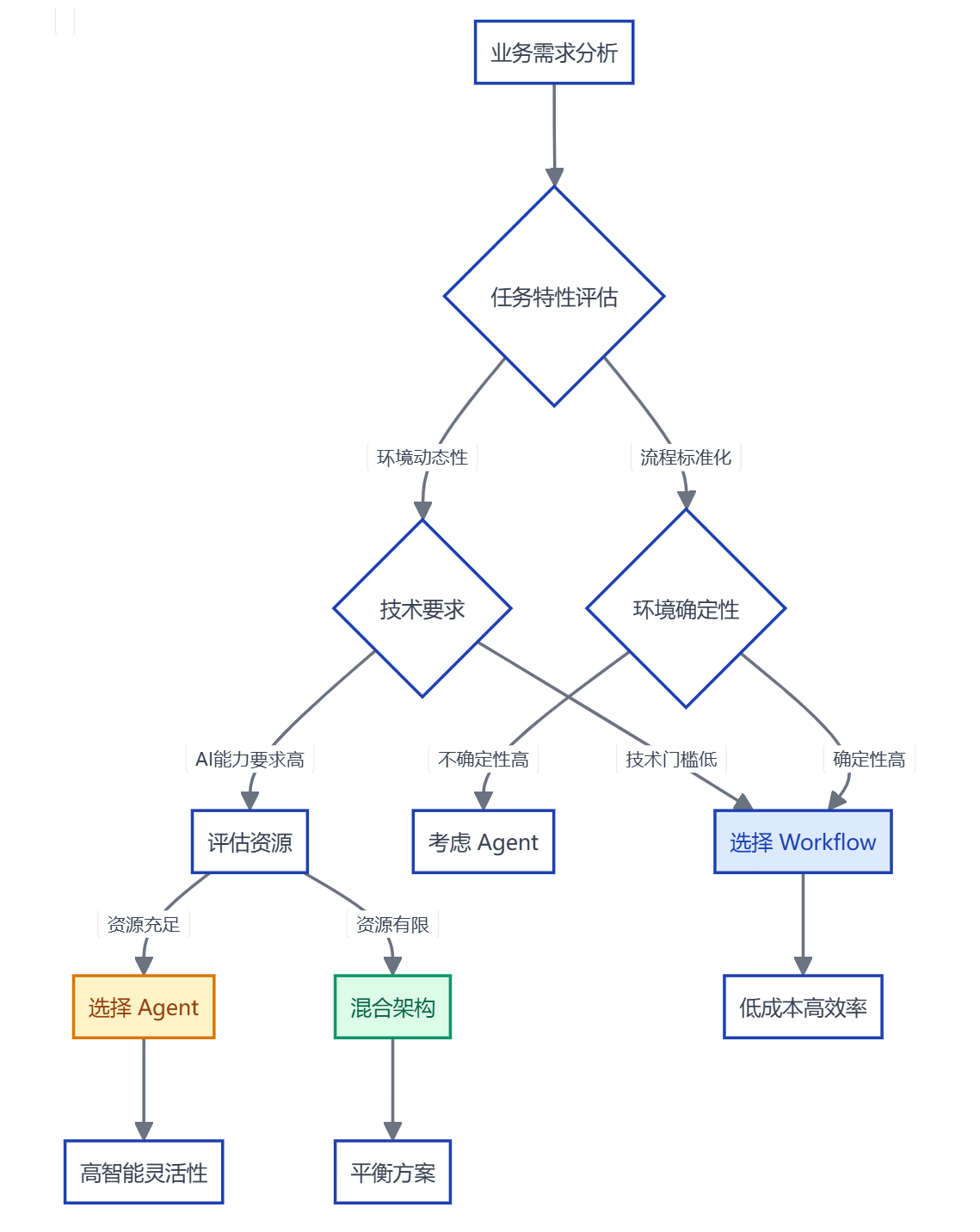
(Technical selection evaluation framework)
Integrated application: leverage the strengths of both
In many complex real-world scenarios, Agent and Workflow are not opposed to each other; they can complement and integrate with each other to achieve a "1+1>2" effect. This hybrid architecture can balance the stability and intelligence of the system.
💡Workflow as the framework, Agent handles key links
Example of integration mode:
Use Workflow as the "skeleton" or "backbone process" of the entire system, responsible for managing and controlling the overall task flow and ensuring the stability and reliability of the core business processes. Then, at certain key nodes in the Workflow, embed Agent to handle those complex subtasks that require intelligent decision-making.
The advantage of this hybrid mode is that it can use Workflow's low cost, high efficiency, and stability to handle most standardized work, while also using Agent's intelligence and flexibility to solve complex problems and improve user experience.
Risk assessment and long-term planning
📌Assess the scalability and maintenance difficulty of different solutions
When choosing a technical solution, one should not only consider immediate needs but also future scalability and the difficulty of long-term maintenance. The Workflow system has a clear structure and is easy to extend and maintain; new steps or rules can be relatively easily integrated into existing processes.
The scalability of an Agent system is more challenging, especially when multiple Agents need to collaborate, as state management and communication mechanisms become very complex.
📌Formulate a long-term technology roadmap that aligns with business development
Technology selection should not be a one-time decision but a long-term planning process that matches business development. Enterprises can formulate a phased technology roadmap based on their own level of digitalization and intelligence.
In the early stage, one can start with simple Workflow automation to solve the most urgent efficiency problems and quickly obtain return on investment. As the business develops and data and talent accumulate, Agent technology can be gradually introduced into key business areas to enhance the intelligence level of the system. Through the deep integration of Workflow and Agent, build an intelligent business ecosystem capable of self-optimization and continuous evolution, maintaining a leading position in fierce market competition.
With the continuous development of technology, the boundary between Agent and Workflow may gradually blur, but the differences in core concepts and application scenarios will persist for a long time. Understanding these differences will help you make wiser choices on the path of digital transformation and build more efficient and intelligent business systems.