
What is Agent-S
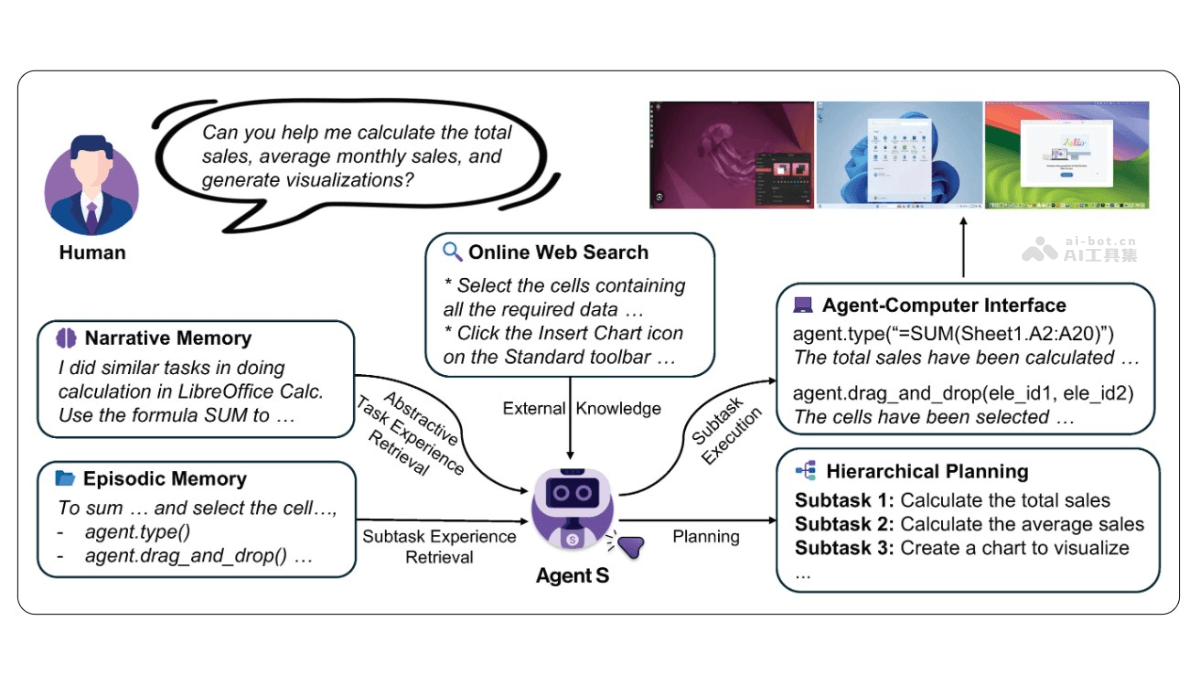
Agent-S is an innovative agent framework designed to automate human-computer interaction based on graphical user interfaces (GUIs). Agent-S is based on simulating human operation, using the mouse and keyboard to interact directly with the computer to handle complex multi-step tasks. Agent-S introduces an experience-enhanced hierarchical planning method, combining online web knowledge and internal memory to decompose complex tasks into manageable subtasks. Agent-S is based on a specific agent-computer interface (ACI), improving the reasoning and control capabilities of GUI agents based on multimodal large language models (MLLMs). Agent-S performs excellently on the OSWorld benchmark, with a success rate significantly higher than the baseline, proving its effectiveness in automating computer tasks. The framework not only improves efficiency but also enhances accessibility through automated interaction, providing people with disabilities a new way to interact with technology.
Main features of Agent-S
- Autonomous interaction and task automation: Agent-S autonomously interacts with the computer based on the graphical user interface (GUI), automating the execution of complex multi-step tasks.
- Experience-enhanced hierarchical planning: The framework uses online web knowledge and internal experience to decompose complex tasks and generate a series of executable subtasks.
- Agent-Computer Interface (ACI):Agent-S uses ACI to improve the reasoning and control capabilities of GUI agents based on multimodal large language models (MLLMs), ensuring precise interaction with the computer interface.
- Continuous learning and memory updates: Agent-S uses self-evaluation and experience summarization to continuously update narrative memory and episodic memory, adapting to environmental changes and improving task execution capabilities.
- Cross-operating system generality: The framework demonstrates good generality across different operating systems and can execute tasks in a variety of environments.
Technical principles of Agent-S
- Experience-enhanced hierarchical planning:Agent-S combines online web search and internal experience retrieval, using narrative memory and episodic memory to plan and execute tasks.
- Agent-Computer Interface (ACI): As an abstraction layer, ACI defines the paradigm for interacting with the environment, using visual input and an image-enhanced accessibility tree to precisely locate elements, restrict the agent's action space, and ensure safe and precise execution.
- Narrative memory and episodic memory: Narrative memory stores high-level task experience, while episodic memory contains specific subtask execution details; together they support task planning and execution.
- Self-evaluation and memory updates: Agent-S uses a self-evaluation module to summarize experience and updates internal memory in the form of textual rewards, enabling continuous learning.
- Multimodal large language models (MLLMs): As the core of reasoning, MLLMs can process and generate language, understand environmental changes, and execute language-based primitive actions to control the GUI.
Project addresses of Agent-S
- Project official website:simular.ai/agent-s
- GitHub repository:https://github.com/simular-ai/Agent-S
- arXiv technical paper:https://arxiv.org/pdf/2410.08164v1
Application scenarios of Agent-S
- Office automation: Handling daily office tasks, such as data entry, scheduling, document creation and editing, and automated operation of office software (such as word processing, spreadsheet calculation, presentation creation, etc.).
- Web interaction: Perform web navigation tasks, such as online shopping, filling out forms, searching for information, managing email accounts, etc.
- Personal Assistant: As a personal assistant, help users manage schedules, remind them of important events, book services (such as restaurants, hotels, airline tickets), etc.
- Customer Service: In the customer service field, automatically handle common inquiries and transactions, providing 24/7 automated support.
- Education and Training: Automate teaching assistance tasks, such as creating teaching materials, grading student assignments, managing online course platforms, etc.