
What is Agent Q
Agent Q is a self-supervised agent reasoning and search framework launched by MultiOn in collaboration with Stanford University. Agent Q integrates techniques such as guided Monte Carlo Tree Search (MCTS), AI self-critique, and Direct Preference Optimization (DPO), enabling AI models to self-improve through iterative fine-tuning and reinforcement learning from human feedback. Agent Q demonstrates outstanding performance in web navigation and multi-step task execution. In real booking tasks on OpenTable, it increased the success rate from 18.6% to 95.4%, marking a major breakthrough in AI autonomy and complex decision-making capabilities.

Main Features of Agent Q
- Guided Search: Uses the Monte Carlo Tree Search (MCTS) algorithm to guide exploration and decision-making in complex environments.
- Self-Critique: Has the ability to self-evaluate, providing feedback at each step to help refine the decision-making process.
- Iterative Fine-Tuning: Through the Direct Preference Optimization (DPO) algorithm, Agent Q can learn from successful and unsuccessful trajectories and continuously optimize its strategy.
- Multi-Step Reasoning Tasks: Agent Q can handle complex tasks requiring multi-step reasoning and decision-making, such as online booking and e-commerce platform operations.
- Zero-Shot Learning: Even without training for a specific task, Agent Q can demonstrate high-success zero-shot performance.
Technical Principles of Agent Q
- Guided Monte Carlo Tree Search (MCTS): Agent Q uses the MCTS algorithm to guide the agent's exploration in web environments. By simulating possible action paths, the algorithm can evaluate and select the optimal actions, thereby balancing the exploration of new information and the use of known information.
- AI Self-Critique: Agent Q generates possible actions at each node and uses the underlying large language model (LLM) to self-evaluate these actions, providing intermediate feedback as intermediate rewards to guide the search steps.
- Direct Preference Optimization (DPO): An offline reinforcement learning method used to optimize strategies, enabling Agent Q to learn from successful and unsuccessful trajectories. The DPO algorithm fine-tunes the model by directly optimizing preference pairs without relying on traditional reward signals.
- Iterative Policy Optimization: Through iterative fine-tuning, Agent Q combines data generated by MCTS and feedback from AI self-critique to construct preference pairs, thereby optimizing model performance.
Agent Q Project Address
- Product Website:multion.ai(Apply for beta testing experience)
- Technical Paper:https://multion-research.s3.us-east-2.amazonaws.com/AgentQ.pdf
Application Scenarios of Agent Q
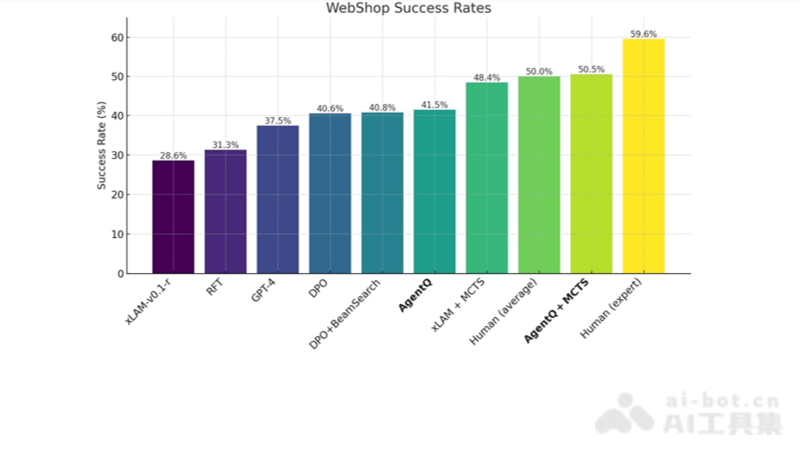
- E-Commerce: In a simulated WebShop environment, Agent Q can automate the browsing and purchasing process, helping users quickly find the products they need and complete transactions.
- Online Booking Services: Agent Q can book restaurant and hotel services for users on online booking platforms such as OpenTable, handling all related steps.
- Software Development: Agent Q can assist software development, from code generation, testing, to documentation writing, improving development efficiency and reducing human errors.
- Customer Service: As an intelligent customer service agent, Agent Q can handle customer inquiries, provide instant feedback, and resolve common issues.
- Data Analysis: Agent Q can analyze large amounts of data, providing enterprises with insights and recommendations to help make more data-driven decisions.
- Personalized recommendations: Agent Q can provide personalized content or product recommendations based on the user's historical behavior and preferences.