
What is Agent Kit
Agent Kit is a complete agent development toolkit launched by OpenAI, helping developers quickly advance AI agents from prototypes to production environments. It includes three core components: Agent Builder, a visual canvas tool that supports drag-and-drop node design for complex workflows without writing code from scratch; ChatKit, a customizable chat interface toolkit that supports embedding your own brand and reduces interaction development costs; and Connector Registry, a central hub for managing data and tool connections. The toolkit includes built-in file search, logic orchestration (such as loops and approval nodes), and security rule configuration, significantly lowering the threshold for agent development.
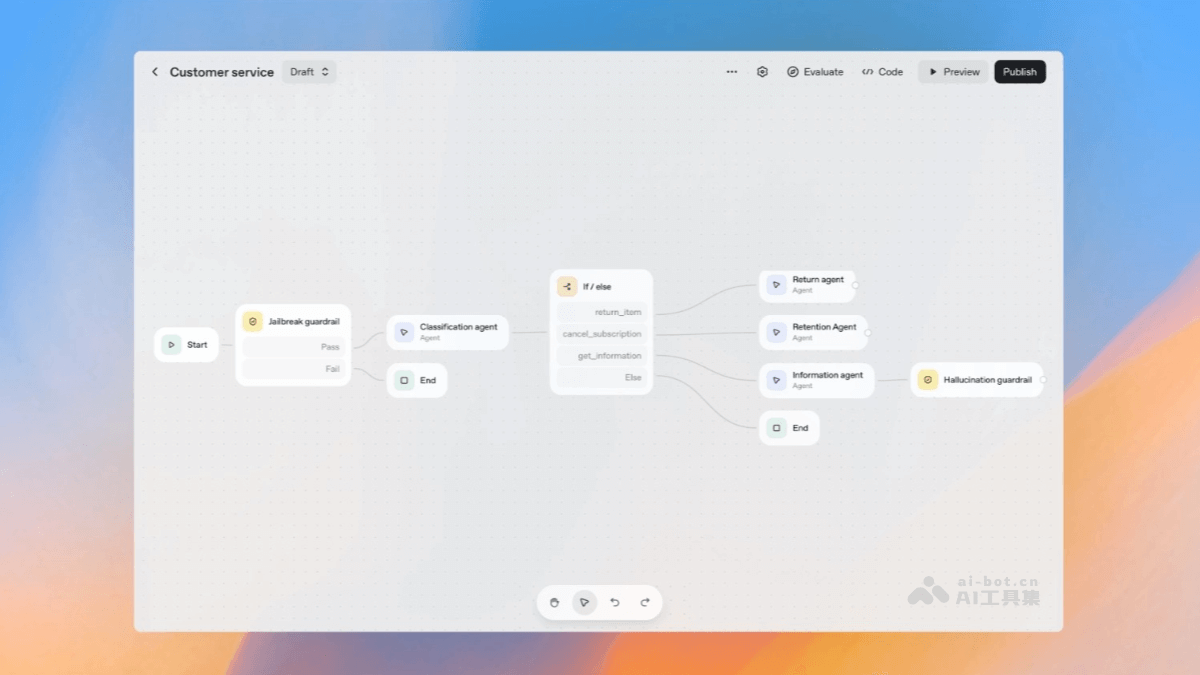
Main features of Agent Kit
- Visual agent building (Agent Builder): Provides a drag-and-drop canvas interface that supports orchestrating logic through nodes, configuring security rules, and integrating tools (such as file search, loops, and approval nodes), enabling the design of complex workflows without writing code.
- Customized chat interaction (ChatKit): Provides an embedded chat interface toolkit that supports brand customization and interaction design, reducing front-end development costs.
- Unified connector management (Connector Registry): Centrally manages secure access to data sources and third-party tools (such as internal systems or applications), ensuring seamless integration between agents and external services.
- Full-chain evaluation and monitoring (Evals): Built-in performance tracking, automated testing, and "trace grading" features for analyzing agent decision-making processes and optimizing their behavior.
- Web search tool: Supports GPT-4o series models in obtaining real-time web information and providing citation sources, with accuracy reaching 90% in benchmark tests.
- File search tool: Supports multi-format document retrieval, metadata filtering, and custom sorting, suitable for knowledge base applications.
- Computer-using agent (CUA): Operates graphical interfaces (such as clicking buttons and entering text) through visual and reasoning capabilities to automate tasks.
Technical principles of Agent Kit
- Modular architecture and visual orchestration: Agent Kit adopts a modular design and provides a visual canvas (Agent Builder). Developers can quickly build workflows by dragging and dropping nodes (such as tool calls, logical judgments, and human approval nodes) without writing low-level coordination code. Its core components include agents, tools, task handoff, and guardrails, achieving efficient integration through the Responses API.
- Multi-agent collaboration and task allocation: Supports multi-agent collaborative work, through
handoffsmechanisms to achieve dynamic allocation and relay execution of complex tasks (such as the division of labor between a research agent and an editing agent), with decision logic (such as if/else judgments) built into the model layer rather than relying on external orchestration. - Tool integration and automated execution: Tools, as key components, cover built-in functions (such as web search and file operations) and custom Python functions, through
@function_tooldecorators to automatically validate inputs and outputs. The agent loop drives the LLM to call tools, execute actions, and iteratively optimize, combining reinforcement learning to improve reasoning capabilities. - Security and control mechanisms: Configure instruction constraints and behavioral boundaries through safety guardrails to reduce ambiguity and errors, while supporting human-in-the-loop nodes to ensure controllability of critical operations. The Connector Registry centrally manages access permissions for data and third-party service integrations.
- Full-Chain Observability and Evaluation: Integrate tracing tools to monitor workflow execution status in real time, support automated evaluation and prompt optimization, and facilitate developer debugging and iteration.
Agent Kit Project Address
- Project Official Website:https://openai.com/index/introducing-agentkit/
Agent Kit Application Scenarios
- Customer Support Automation: Handle common questions through an intelligent Q&A assistant, support multi-turn conversations and natural language understanding, and can be integrated into websites, apps, or social media platforms to provide 24/7 service and significantly improve customer service efficiency.
- Multi-Step Research and Data Analysis: Automate complex research processes such as literature retrieval, data analysis, and result visualization, suitable for research institutions and corporate R&D departments, improving research efficiency.
- Content Generation and Creation: Assist creators in generating high-quality text, image, and video content, suitable for blogs, social media, advertising, and other channels, improving content production efficiency and creativity.
- Code Review and Software Development: Provide software engineers with an advanced coding assistant that supports code review, automated testing, and complex task management, improving development efficiency and code quality.
- Sales and Marketing Automation: Used to filter and rank sales leads, automate prospect development, marketing, and customer follow-up, improving sales conversion rates and marketing effectiveness.