
What is AdaCache
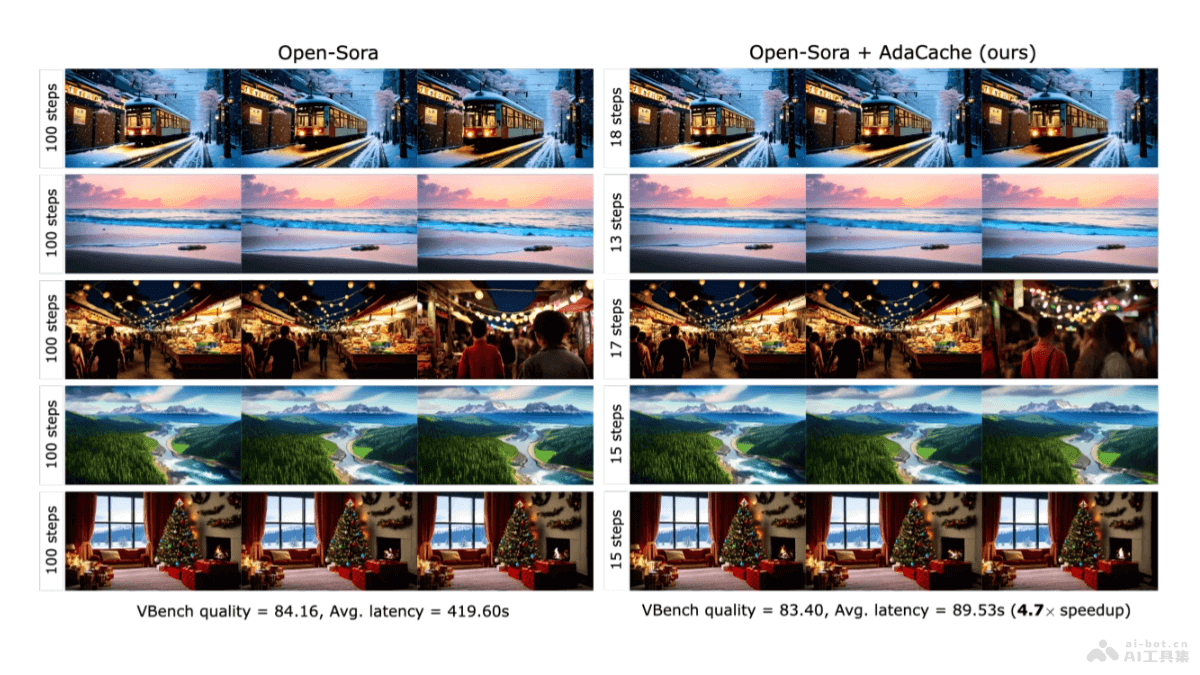
AdaCache (Adaptive Caching) is an open-source technology launched by Meta that can accelerate the AI video generation process. The AdaCache adaptive caching mechanism optimizes the allocation of computational resources, dynamically adjusts the amount of computation according to the complexity of different video content, and reduces unnecessary computational overhead. AdaCache introduces a motion regularization strategy, using motion information within the video to further optimize caching decisions. Experiments show that AdaCache significantly improves generation speed while maintaining video quality, with notable effects in multi-GPU environments, and has important application value and development prospects in the field of video generation.
AdaCache's main features
- Adaptive caching mechanism: One of AdaCache's core features is the adaptive caching mechanism, which dynamically determines whether residual connections (such as attention or MLP outputs) need to be recomputed based on changes in video content. It is implemented based on the rate of change between the current residual and the residual from the previous step, avoiding unnecessary repeated computation.
- Motion regularization (MoReg): AdaCache introduces a motion regularization strategy that uses motion information in the video to adjust the caching plan. This helps reasonably allocate computational resources when processing highly dynamic videos, ensuring that generation quality is maintained while improving speed.
- Quality-latency trade-off: AdaCache can maximize the quality-latency trade-off of video generation, providing an optimal computational resource allocation plan for each video generation task based on a customized caching strategy.
- Plug-and-play component: As a training-free plug-and-play component, AdaCache can be easily integrated into existing video DiT models, improving inference speed without retraining.
AdaCache's technical principles
- Cache decisions based on rate of change: AdaCache uses distance metrics (such as L1 distance) to measure changes in residual connections between different diffusion steps. If the rate of change is below a certain threshold, the cached computation result is reused; otherwise, recomputation is required.
- Dynamic caching plan: Based on the rate of change of video content, AdaCache dynamically formulates a caching plan, that is, deciding when to recompute residuals. This decision mechanism enables AdaCache to reduce computation while maintaining video quality.
- Utilization of motion information: AdaCache calculates a noise latent motion score based on estimated residual frame differences and introduces motion gradients as predictors of early motion trends. Motion information is used to adjust the caching plan, especially increasing computational resources when there is more motion in the video content.
- Optimization in multi-GPU environments: In multi-GPU parallel computing environments, AdaCache can reduce communication overhead between GPUs and avoid repeated computational tasks based on the caching mechanism, further improving the efficiency of video generation.
AdaCache's project addresses
- Project official website:adacache-dit.github.io
- GitHub repository:https://github.com/AdaCache-DiT/AdaCache
- arXiv technical paper:https://arxiv.org/pdf/2411.02397
AdaCache's application scenarios
- Film and television production: In the post-production of films and TV series, it accelerates processes such as special effects generation and scene rendering, shortens production cycles, and reduces costs.
- Video editing software: In video editing tools, it enables real-time preview and fast processing, improves the performance of non-linear editing (NLE) software, and enhances the user experience.
- Online video platforms: For online platforms that need to quickly generate and process large amounts of video content (such as YouTube, TikTok, etc.), improve the production efficiency of video content and meet users' demand for high-quality video content.
- Social Media: On social media platforms, accelerate the processing of user-generated content (UGC), such as real-time video filters, special effects addition, etc.
- Virtual Reality (VR) and Augmented Reality (AR): In VR and AR applications, improve the rendering speed of video content to bring users a smoother immersive experience.