
What Is Absolute Zero
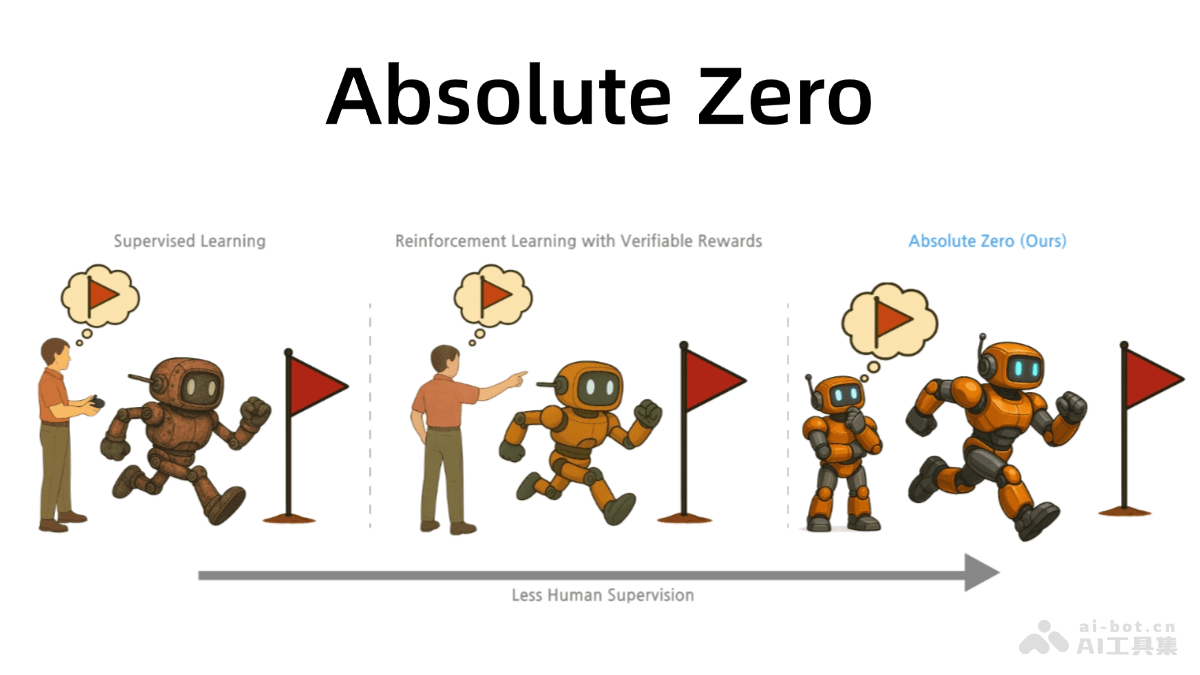
Absolute Zero is a new language model reasoning training method introduced by the LeapLab team at Tsinghua University in collaboration with the NLCo Lab at the Beijing Institute for General Artificial Intelligence and Pennsylvania State University.Absolute Zero is based on the model self-proposing tasks and autonomously solving them, achieving self-evolutionary learning without relying on human-annotated data or predefined tasks. The model receives learnability rewards when proposing tasks and solution rewards when solving problems, continuously optimizing its own reasoning ability based on interaction with the environment. The core of Absolute Zero lies in driving reasoning models to shift from relying on human supervision to relying on environmental supervision, allowing the model to improve performance by generating verifiable tasks using feedback from the real environment.
Main Features of Absolute Zero
- Autonomous Task Generation: The model autonomously proposes learnable tasks that are neither too simple nor too complex, providing effective learning signals for the model.
- Autonomous Task Solving: The model acts as a solver, attempting to solve tasks it has proposed or generated, and verifying the correctness of solutions based on environmental feedback.
- Improved Reasoning Ability: By continuously proposing and solving tasks, the model's reasoning abilities (such as deduction, induction, abduction, etc.) are continuously enhanced.
- Cross-Domain Generalization: The general reasoning ability acquired by the model through self-learning is transferred to new tasks and domains.
- Zero-Data Training: It does not rely at all on manually annotated data or human-designed tasks, and learns based on interaction with and feedback from the environment.
Technical Principles of Absolute Zero
- Dual-Role Model: The model simultaneously plays two roles: task proposer (Proposer) and task solver (Solver). The proposer generates tasks, and the solver attempts to solve them. Both share model parameters and are optimized synchronously.
- Environmental Feedback Mechanism: The model interacts with the environment (such as a code executor), and the environment verifies the solvability of tasks and provides feedback. Proposed tasks receive learnability rewards (based on the difficulty of the task and the model's solution success rate), and solved tasks receive solution rewards (based on the correctness of the solution).
- Reinforcement Learning Optimization: Reinforcement learning algorithms (such as TRR++) are used to optimize model parameters, combining learnability rewards and solution rewards to achieve self-evolutionary learning under multiple tasks.
- Reasoning Mode Support: It supports three basic reasoning modes: deduction, abduction, and induction. Each reasoning mode corresponds to different task types, and the model improves specific reasoning abilities by solving these tasks.
- Self-Play Closed Loop: The model continuously proposes new tasks, solves tasks, and updates strategies based on environmental feedback, forming a closed-loop self-play learning process. The closed-loop mechanism ensures that the model continuously optimizes its own capabilities without external data support.
Project Addresses for Absolute Zero
- Project Official Website:https://andrewzh112.github.io/absolute-zero-reasoner/
- GitHub Repository:https://github.com/LeapLabTHU/Absolute-Zero-Reasoner
- HuggingFace Model Library:https://huggingface.co/collections/andrewzh/absolute-zero-reasoner
- arXiv Technical Paper:https://www.arxiv.org/pdf/2505.03335
Application Scenarios of Absolute Zero
- Artificial General Intelligence (AGI): It promotes autonomous learning and evolution of models, gradually approaching the level of human intelligence.
- Code Generation: It automatically generates efficient code, solves complex programming problems, and improves development efficiency.
- Mathematical reasoning: enhance the model's generalization ability on mathematical problems, and assist mathematics education and research.
- Natural Language Processing (NLP): improve language understanding and generation capabilities based on self-learning, and optimize text generation and question answering systems.
- Security and ethics: study behavioral patterns in AI autonomous evolution to ensure system safety and ethicality.