
What is abogen
abogen is a powerfultext-to-speech tool, supporting rapid conversion of ePub, PDF, or text files into high-quality audio, and can generate synchronized subtitles. abogen is based on the Kokoro-82M model, supports multiple languages and voice styles, and users can adjust speech rate, select voices, set subtitle styles, etc., through simple configuration. The tool features a voice mixer, queue mode, chapter markers, and more, facilitating batch processing and personalized creation. It is suitable for producing audiobooks, social media narrations, and more, making it a powerful assistant for content creators.
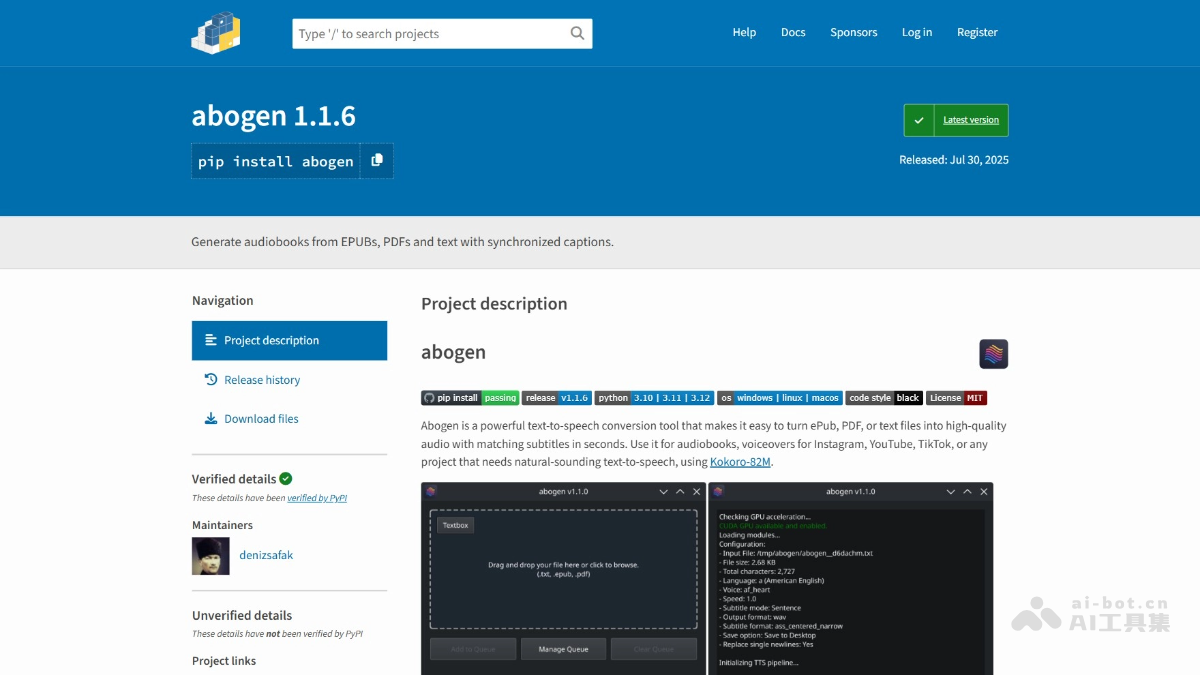
Main features of abogen
- Text-to-speech: Can convert ePub, PDF, or plain text files into high-quality audio files, supporting multiple output formats (such as WAV, FLAC, MP3, OPUS, M4B).
- Synchronized subtitle generation: While generating audio, it can generate subtitle files synchronized with the audio (such as SRT, ASS formats), facilitating video content creation.
- Voice customization: Through the voice mixer feature, users can mix different voice models to create personalized voice styles and save them as custom configurations.
- Batch processing: Supports queue mode, allowing users to add multiple files to a queue and process them in batches sequentially, with independent settings for each file.
- Chapter management: Automatically adds chapter markers to ePub and PDF files, supports saving audio files by chapter, facilitating management and playback.
- Metadata support: Adds metadata (such as title, author, year, etc.) to generated audio files, making them easier to use in players that support metadata.
- Multi-language support: Supports multiple languages (such as American English, British English, Spanish, French, Japanese, etc.), meeting the needs of different users.
- User-friendly interface: Provides a graphical interface, allowing users to operate easily through drag-and-drop files, adjusting settings, and more.
Technical principles of abogen
- Based on the Kokoro model: abogen uses the Kokoro-82M model for text-to-speech conversion. Kokoro is an advanced speech synthesis model that can generate natural and fluent speech, supporting multiple languages and voice styles.
- Voice mixing technology: Based on the voice mixer, abogen supports users in mixing different voice models and adjusting the weights of each model to create unique voice styles, enabling users to generate personalized voices according to their needs.
- Subtitle synchronization technology: During speech synthesis, abogen can generate subtitle files synchronized with the audio. This is achieved by recording the start and end timestamps of each word or sentence during speech synthesis, ensuring a perfect match between subtitles and audio.
- Cross-platform support: abogen supports Windows, Mac, and Linux systems, and implements a cross-platform graphical interface based on Python and related libraries (such as PyQt5), making it convenient for users to use on different operating systems.
abogen project address
- Project website:https://pypi.org/project/abogen/
- GitHub repository:https://github.com/denizsafak/abogen
Application scenarios of abogen
- Audiobook production: Quickly converts e-books (ePub, PDF) into audio files (such as MP3, M4B), allowing users to listen to books anytime and anywhere, with support for personalized voice style adjustments.
- Social media video production: Generate natural voiceovers and synchronized subtitles (SRT, ASS formats) for videos on Instagram, YouTube, TikTok, etc., enhancing content appeal and professionalism.
- Education and Learning Assistance: Convert learning materials (PDFs, e-books) into audio, making it convenient for students to study during commutes or exercise, with multilingual speech synthesis support to aid language learning.
- Podcast Content Creation: Efficiently convert text content into audio for podcast production, allowing users to freely choose voice style and speech rate for personalized podcast creation.
- Assistance for the Visually Impaired: Read text aloud as speech for the visually impaired, helping users easily access information and improving convenience in life and learning.