
What is A2A
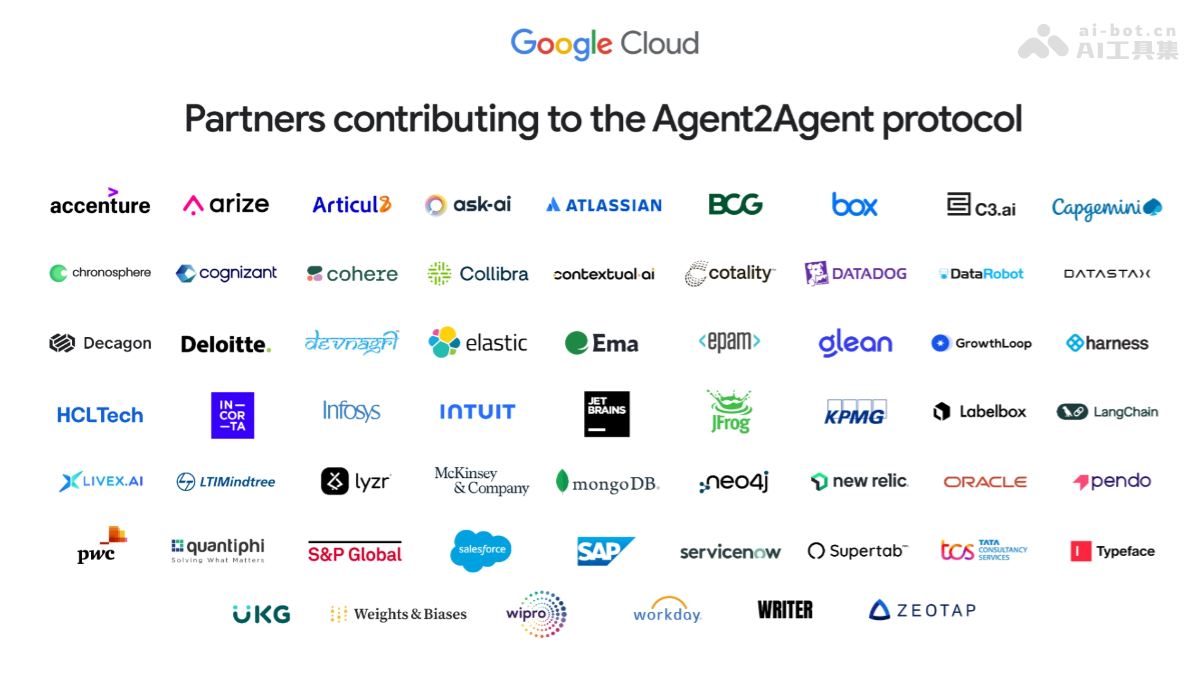
A2A (Agent2Agent Protocol) is Google's first open-source standard agent interaction protocol, enabling AI agents built with different frameworks and vendors to collaborate with each other. A2A is based on standardized communication methods, breaking down system silos and allowing agents to securely exchange information and coordinate actions. A2A supports multiple modalities (such as text, audio, and video), long-running task processing, and real-time feedback. It is built on existing standards (such as HTTP and JSON-RPC), making it easy to integrate with existing IT systems. More than 50 companies joined in the first batch, including Atlassian, Box, MongoDB, and others.
Main features of A2A
- Facilitates agent collaboration: A2A supports seamless collaboration between AI agents built with different frameworks and vendors.
- Supports multiple modalities: A2A supports multiple interaction methods such as text, audio, and video, meeting the needs of different scenarios.
- Task management and status updates: A2A defines a "task" object with a lifecycle (such as submitted, in progress, input required, completed, failed, and canceled). For long-running tasks, such as complex data analysis or long-term file processing, A2A provides real-time feedback to users on task progress and status updates.
- User experience negotiation: A2A supports negotiation of user experience between agents, adjusting the interaction method according to the user's device and preferences.
- Security and authentication: A2A supports enterprise-grade authentication and authorization, ensuring the security and compliance of data exchange.
Design principles of A2A
- Leverage agent capabilities: Supports agents collaborating in a natural, unstructured mode.
- Based on existing standards: Based on existing standards such as HTTP, SSE, and JSON-RPC, making it easy to integrate with existing IT systems.
- Secure by default: Supports enterprise-grade authentication and authorization, consistent with OpenAPI's authentication schemes.
- Supports long-term tasks: Supports tasks ranging from quick tasks to in-depth research tasks that may take hours or even days, providing real-time feedback and status updates.
- Modality-agnostic: Supports multiple interaction methods such as text, audio, and video.
How A2A works
- Capability discovery: Agents advertise their capabilities based on an "Agent Card" (in JSON format), and client agents can identify and select the most suitable agent to perform a task.
- Task management: Communication between the client and the remote agent is oriented toward task completion. The task object has a lifecycle and supports either immediate completion or long-running operation.
- Collaboration: Agents can send messages to convey context, replies, task outputs, or user instructions.
- User experience negotiation: Each message contains "parts", which are complete content fragments. Each part has a specified content type, supporting negotiation between the client and the remote agent on the correct format.
Technical principles of A2A
- Agent Card: The agent's "business card", storing the agent's capabilities, skills, endpoint URL, and authentication requirements in JSON format. The client obtains the Agent Card by accessing /.well-known/agent.json, discovering and selecting the appropriate agent for collaboration.
- A2A Server and A2A Client: The A2A Server is an HTTP endpoint that implements the A2A protocol methods, responsible for receiving requests and managing task execution; the A2A Client is a client or another agent that sends requests (such as tasks/send). The two communicate based on the HTTP protocol.
- Tasks and Messages: A task is the core unit of work in A2A. The client sends a message (containing the task description) to start a task. A message consists of multiple "parts", including text, files, or structured data. During execution, the task goes through different states, and the states are fed back to the client in the form of messages.
- Streaming and Push Notifications: For long-running tasks, A2A supports streaming (Server-Sent Events, SSE), allowing the client to receive task progress updates in real time. A2A supports push notifications, where the server proactively sends task updates based on the Webhook URL provided by the client.
- Based on Existing Standards: The A2A protocol is built on existing popular standards (such as HTTP, SSE, and JSON-RPC), supports integration into existing IT architectures, and lowers the barrier to enterprise adoption.
A2A Partners
A2A has already gained support from more than 50 technology partners and service providers, including Atlassian, Articul8, Arize AI, Box, C3 AI, BCG, Capgemini, Cognizant, and others.
A2A Project Address
- Project Official Website:https://developers.googleblog.com/en/a2a
- GitHub Repository:https://github.com/google/A2A
A2A Application Scenarios
- Enterprise Process Automation: Connect systems across different departments to automatically complete tasks such as order processing and inventory management.
- Cross-Platform Customer Service: Integrate intelligent customer service across multiple platforms to provide more comprehensive and timely customer support.
- Recruitment Process Optimization: Coordinate multiple recruitment platforms and internal systems to quickly screen candidates and schedule interviews.
- Supply Chain Collaboration: Share information from all stages of the supply chain in real time to optimize inventory and logistics.
- Smart Office: Integrate agents in office tools to automatically schedule meetings and remind about tasks, improving collaboration efficiency.