
What is 3DIS-FLUX
3DIS-FLUX is a multi-instance generation framework based on deep learning, achieving high-quality image generation through decoupled instance synthesis. Combining the depth-driven scene construction of the 3DIS framework with the diffusion transformer architecture of the FLUX model, it is divided into two stages: first generating a scene depth map, then performing detail rendering based on the FLUX model. Through attention mechanism control, it ensures that each instance's image tokens only attend to the corresponding text tokens, achieving precise instance rendering. 3DIS-FLUX requires no additional training of the pretrained model, retaining strong generative capabilities while significantly outperforming traditional methods in instance success rate and image quality.
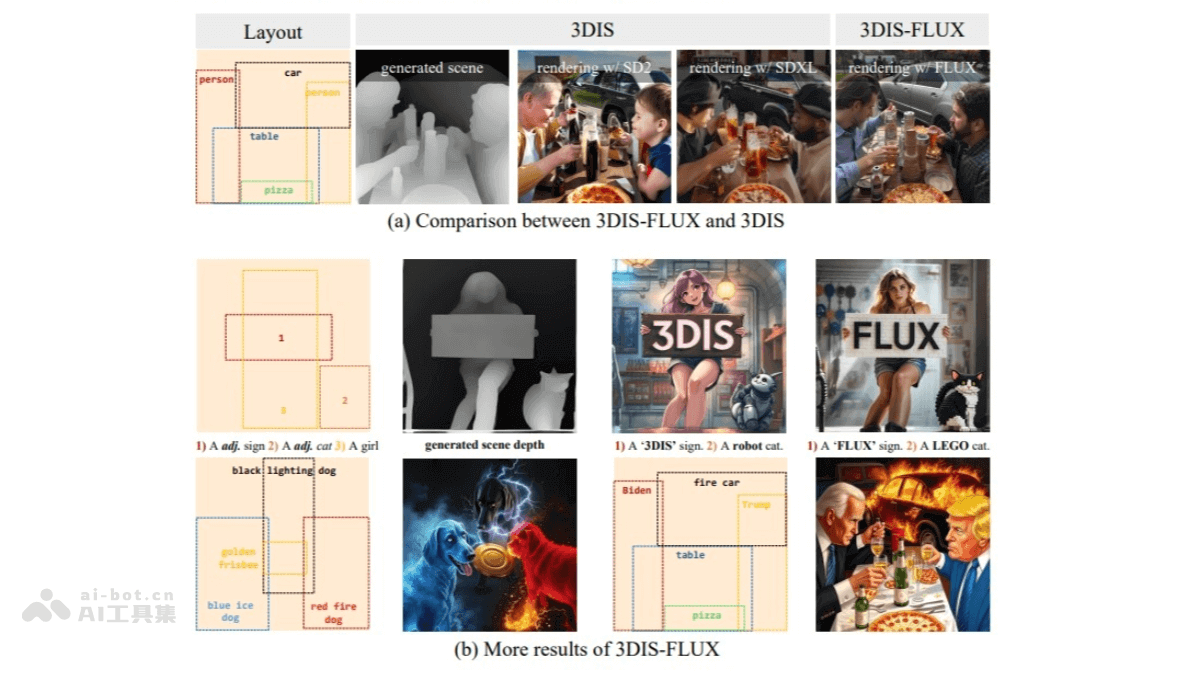
Main Features of 3DIS-FLUX
-
Depth-Driven Scene Construction: 3DIS-FLUX divides multi-instance generation into two stages. First, it generates a scene depth map through a layout-to-depth model, which is used for accurate instance localization and scene layout.
-
Detail Rendering and Attribute Control: In the second stage, 3DIS-FLUX uses the FLUX.1-Depth-dev model for detail rendering. By introducing a detail renderer, it manipulates the attention mask in FLUX's joint attention mechanism based on layout information, ensuring that each instance's fine-grained attributes (such as color, shape, etc.) can be rendered precisely.
-
No Additional Training Required: The framework only requires adapter training in the scene construction stage, and no additional training of the pretrained model is needed in the detail rendering stage, significantly reducing resource consumption.
-
Improved Performance and Quality: Experiments show that 3DIS-FLUX outperforms traditional methods in instance success rate and image quality, such as the 3DIS frameworks based on SD2 and SDXL, as well as current state-of-the-art adapter methods.
-
Flexibility and Compatibility: 3DIS-FLUX is compatible with a variety of pretrained models and can be seamlessly integrated into existing generative AI systems.
Technical Principles of 3DIS-FLUX
-
Two-Stage Generation Pipeline
-
Scene Construction Stage: A Layout-to-Depth Model is used to generate a scene depth map based on the layout information provided by the user. This stage requires adapter training to ensure that the scene layout is consistent with the user-defined instance positions.
-
Detail Rendering Stage: Based on the FLUX.1-Depth-dev model, a high-quality RGB image is generated from the depth map. This stage requires no additional training and directly uses the pretrained FLUX model for rendering.
-
-
Integration of the FLUX Model: FLUX is an advanced model based on the Diffusion Transformer (DiT), with strong text control capabilities and image generation quality. In the detail rendering stage, 3DIS-FLUX aligns image and text embeddings through FLUX's Joint Attention mechanism, and uses an Attention Mask to ensure that each instance's image tokens only attend to their corresponding text tokens.
-
Optimization of the Attention Mechanism: To further improve the rendering precision of instance fine-grained attributes, 3DIS-FLUX introduces a Detail Renderer, which ensures the rendering precision of each instance by manipulating the attention mask in FLUX's joint attention mechanism.
3DIS-FLUX Project Address
- Arxiv Technical Paper:https://arxiv.org/pdf/2501.05131
Application Scenarios of 3DIS-FLUX
-
E-commerce Design and Poster Generation: 3DIS-FLUX can be used to generate high-quality e-commerce product images and poster designs. By defining the layout and attributes of multiple instances, users can quickly generate scene images containing multiple products, meeting the high requirements for product display and visual effects in e-commerce design.
-
Creative Design and Artistic Creation: It can support creative design and artistic creation, generating multi-instance images with fine attributes, such as natural scenery, urban landscapes, portraits, etc. Users can generate complex scenes that meet creative needs through text descriptions and layout definitions.
-
Virtual Scene Construction: 3DIS-FLUX can be used to construct virtual scenes, such as game backgrounds, virtual exhibitions, etc. Through the combination of depth maps and detail rendering, it can generate multi-instance images with a sense of space and realism, meeting the precise requirements for object layout and details in virtual scenes.
-
Advertising and Marketing Content Generation: In the fields of advertising and marketing, 3DIS-FLUX can quickly generate visual content containing multiple elements, such as advertising posters, promotional images, etc.