
What is 3DHM
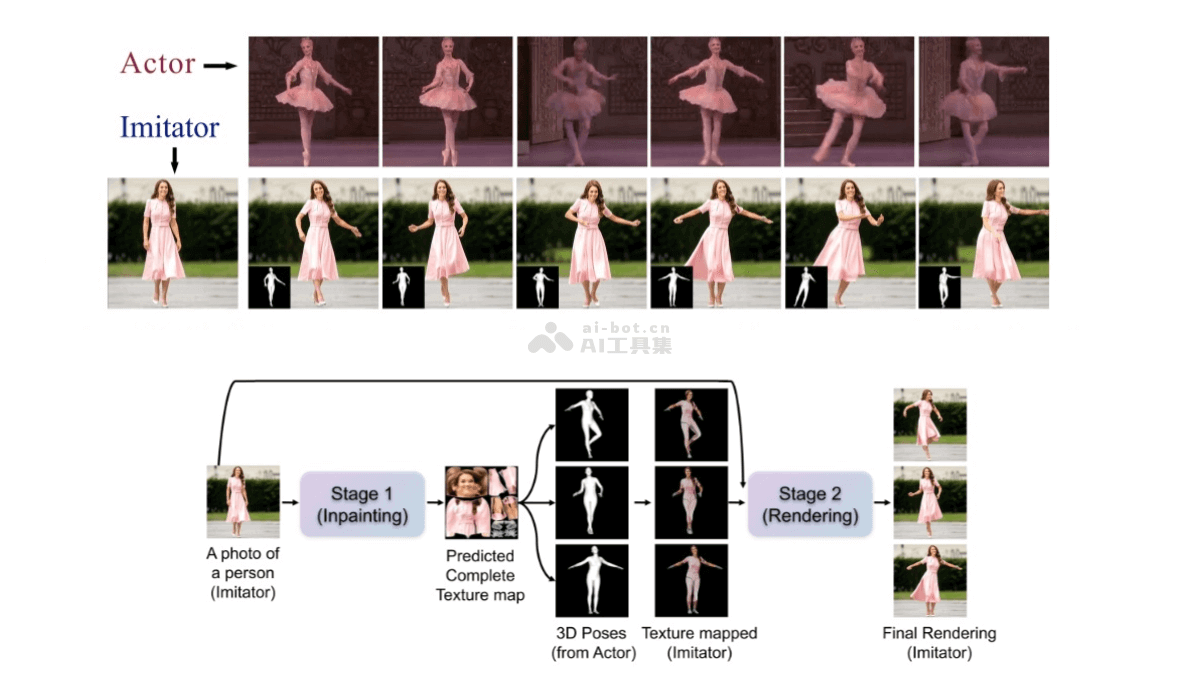
3DHM (3D Human Motions) is an advanced 3D human motion generation technology launched by researchers at the University of California, Berkeley. It can generate dynamic human videos with 3D control from a single photo of a person, realizing the transformation from static images to dynamic videos. The technology renders new body poses with appropriate clothing and textures by learning prior knowledge of the invisible parts of the human body and combining it with a given 3D motion sequence. 3DHM has a wide range of applications, including film special effects, virtual reality, and game development, providing new possibilities for animation production and human motion simulation.
Main Features of 3DHM
- Motion Generation: 3DHM can generate corresponding 3D human motions based on text descriptions, such as running, dancing, playing basketball, etc.
- Motion Editing: Supports mask-based editing functionality, allowing users to specify specific parts of a motion for editing, such as changing the duration or details of the motion.
- Motion Evaluation: Provides evaluation scripts for assessing the quality and realism of generated motions.
- Texture Pattern Repair: Generates incomplete texture patterns from a single photo and repairs them using a diffusion model to generate complete texture patterns.
- Human Rendering: A rendering pipeline based on 3D human pose control that can generate realistic renderings of the target person in different poses, including reasonable filling of clothes, hair, and invisible areas.
- Motion Imitation: The 3DHM framework can imitate motions in a target video, including limb movements as well as changes in clothing and the person's appearance.
- 3D Control: 3DHM can use various synthetic camera trajectories to render the person, generating a series of 3D poses faithful to the target motion and images visually more similar to the input.
Technical Principles of 3DHM
- Texture Pattern Repair (Inpainting Diffusion): Generates incomplete texture patterns from a single photo and uses a diffusion model to repair them to generate complete texture patterns. First, extract the partially visible texture pattern and its corresponding mask from the given single photo. Then, feed these inputs into the diffusion model to generate a complete texture pattern containing unseen areas.
- Human Rendering (Rendering Diffusion): In the second stage, the goal is to obtain a more realistic rendering of the person, including details such as clothing, hairstyle, and body shape. Apply the texture pattern generated in the first stage to the actor's 3D body mesh sequence to generate an intermediate rendering of an imitator performing the actor's motion. Then, feed the obtained intermediate rendering and the original person photo into the rendering diffusion, thereby rendering a person with a realistic appearance based on the given input.
- Prediction Model 4DHumans:: The 3DHM framework fully leverages the advantages of accurate 3D pose prediction from the state-of-the-art prediction model 4DHumans. The model can accurately track human motions and extract the 3D human poses from an actor's video.
3DHM Project Address
- Project Website:https://boyiliee.github.io/3DHM
- Github Repository:https://github.com/Boyiliee/3DHM
- arXiv Technical Paper:https://arxiv.org/pdf/2401.10889
Application Scenarios of 3DHM
- Film Special Effects Production: 3DHM can be used to generate complex character animations, reducing the workload of manual animation production and improving the realism and efficiency of film special effects.
- Virtual Reality (VR): In VR applications, 3DHM can be used to generate a 3D model of the user's body in real time, enhancing the user's sense of immersion and interactive experience.
- Game Development: Game developers can use 3DHM to quickly generate diverse character animations, improving the richness of games and development efficiency.
- Dance and Gymnastics: 3DHM can generate high-quality video content for movements such as dance or gymnastics, making it suitable for digital presentation in sports training and performing arts.
- Motion Imitation: 3DHM can imitate the movements in a target video, including body movements as well as changes in clothing and character appearance, making it suitable for motion capture and animation production.