
What is 3DFY.ai
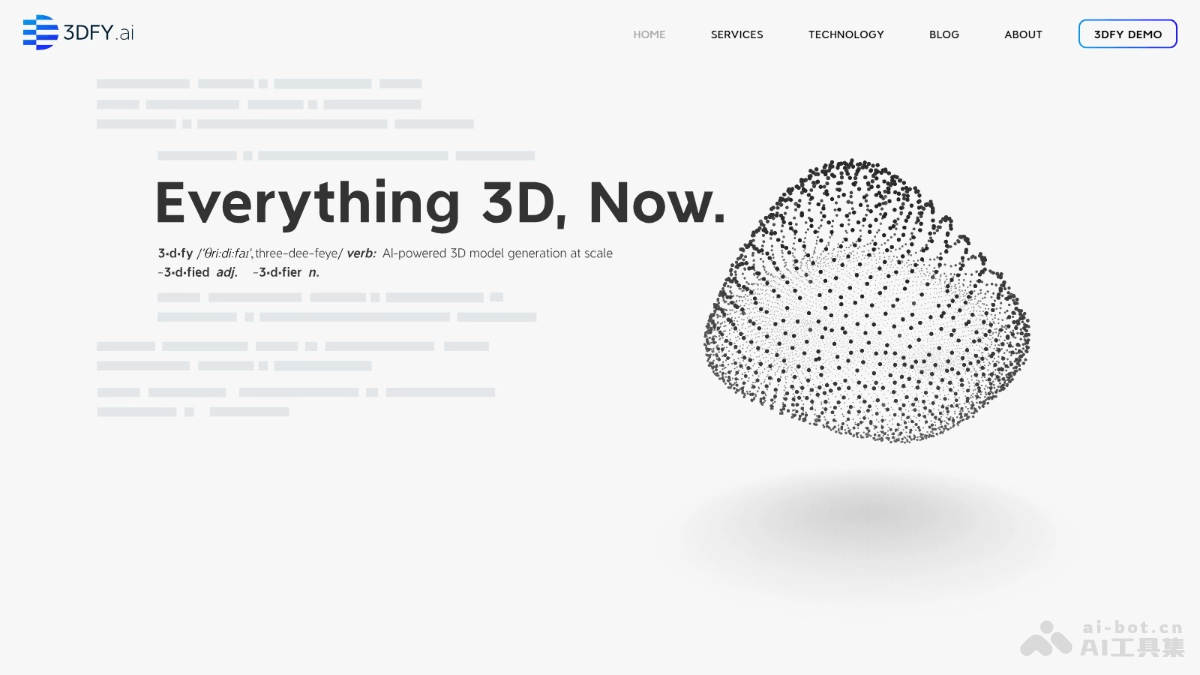
3DFY.ai is based on generativeAI 3D model generationplatform, capable of quickly converting text descriptions into high-quality 3D models. The platform is based on an automated generation process, eliminating manual labor in traditional 3D modeling and enabling large-scale 3D asset creation. 3DFY.ai greatly simplifies the complex process of traditional 3D modeling, reducing production costs and time. The platform is widely used in online retail, game development, AR/VR, and other fields, helping users improve creative efficiency, enrich virtual experiences, and promote the popularization of 3D content creation.
Main Features of 3DFY.ai
- 3DFY Prompt playground: A text-to-3D model service for individual creators, supporting users to generate 3D models with text descriptions, suitable for personal projects and creative expression.
- 3DFY Prompt API: A text-to-3D API for enterprise integration, allowing enterprises to integrate generative 3D capabilities into their own applications based on the API, suitable for large-scale 3D asset needs.
- 3DFY Megapacks: A large-scale 3D dataset generation service for enterprise customers.
- 3DFY Image: An image-to-3D service that generates high-quality 3D models from several existing images.
3DFY.ai Official Website Address
- Official Website Address:3dfy.ai
Application Scenarios of 3DFY.ai
- Online Retail: Furniture e-commerce generates 3D models of furniture, allowing consumers to view product details from all angles and improving the accuracy of purchase decisions.
- Game Development: Game designers quickly generate 3D models of characters, verify whether the design meets expectations, and accelerate the game development process.
- AR/VR: AR education applications generate 3D models of historical buildings, allowing users to overlay virtual buildings in real-world scenes and enhancing the learning experience.
- Simulation and Emulation: Autonomous driving R&D teams generate 3D models of road scenes, build virtual driving environments, train autonomous driving algorithms, and improve system safety.
- Design and Creativity: Industrial designers generate 3D models of electronic products, quickly verify design feasibility, and shorten the product development cycle.