
The "2026 China Internet and AI Large Model Content Risk Control Industry Development Research Report" focuses on the content risk control market in the era of AI large models. The report defines a full lifecycle monitoring system for UGC/PGC/AIGC, predicts that the market size of third-party risk control based on large model technology will grow from 1.18 billion yuan in 2023 to 9.37 billion yuan in 2030 (compound annual growth of over 30%), outlines the industry chain map, 16 categories of content security risks, and full-chain protection technologies for large models, and analyzes practice cases of leading vendors such as NetEase Zhioi-Yidun and 360, providing panoramic insights for the industry.


Scan the QR code to follow the official account, and reply with the keyword:20260618, to receive the PDF report for free
Basic Report Information
- Report Name: 2026 China Internet and AI Large Model Content Risk Control Industry Development Research Report
- Publishing Institution: iResearch
- Publication Time: June 2026
- Report Positioning: Focuses on the market landscape, technology system, industry chain, and future trends of the content risk control industry in the era of AI large models
Definition and Scope of Content Risk Control
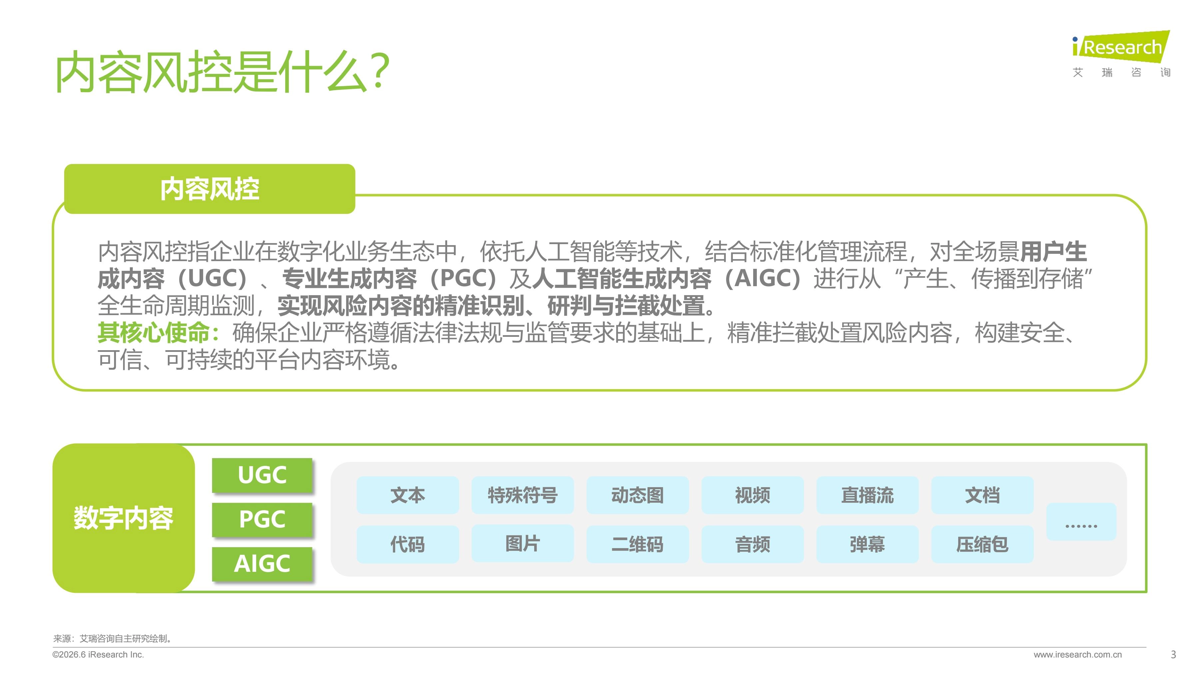
- What Is Content Risk Control: Content risk control refers to enterprises in the digital business ecosystem relying on technologies such as artificial intelligence, combined with standardized management processes, to monitor user-generated content, professionally generated content, and artificial intelligence-generated content across all scenarios throughout the full lifecycle from generation and dissemination to storage, achieving precise identification, assessment, and interception and handling of risky content.
- Core Mission: On the basis of ensuring that enterprises strictly comply with laws, regulations, and regulatory requirements, precisely intercept and handle risky content, and build a safe, trustworthy, and sustainable platform content environment.
- Digital Content Coverage Forms
- UGC: Text, special symbols, animated images, video, live streams, documents
- PGC: Code, images, QR codes, audio, bullet comments, compressed packages
- AIGC: AI-generated text, images, video, audio, and other all-modal content
Industry Development Background and Market Size
- Development Background: The AI wave is driving content risk control into a new era. Currently, the market still relies on traditional review models such as manual review and traditional rule-based machine review, which still occupy more than 50% of the market share and have gradually become unable to meet business requirements for real-time performance, accuracy, and controllable costs. A new generation of intelligent risk control systems is gradually replacing traditional review models.
- Dual-Wheel Growth Logic
- Stock Replacement: Traditional manual and rule-based review is being replaced by intelligent risk control systems, achieving cost reduction and efficiency improvement as well as comprehensive coverage.
- Incremental Creation: Scenario expansion and content growth (the explosion of short videos, live streaming, and AIGC) push the boundaries of risk control to extend infinitely.
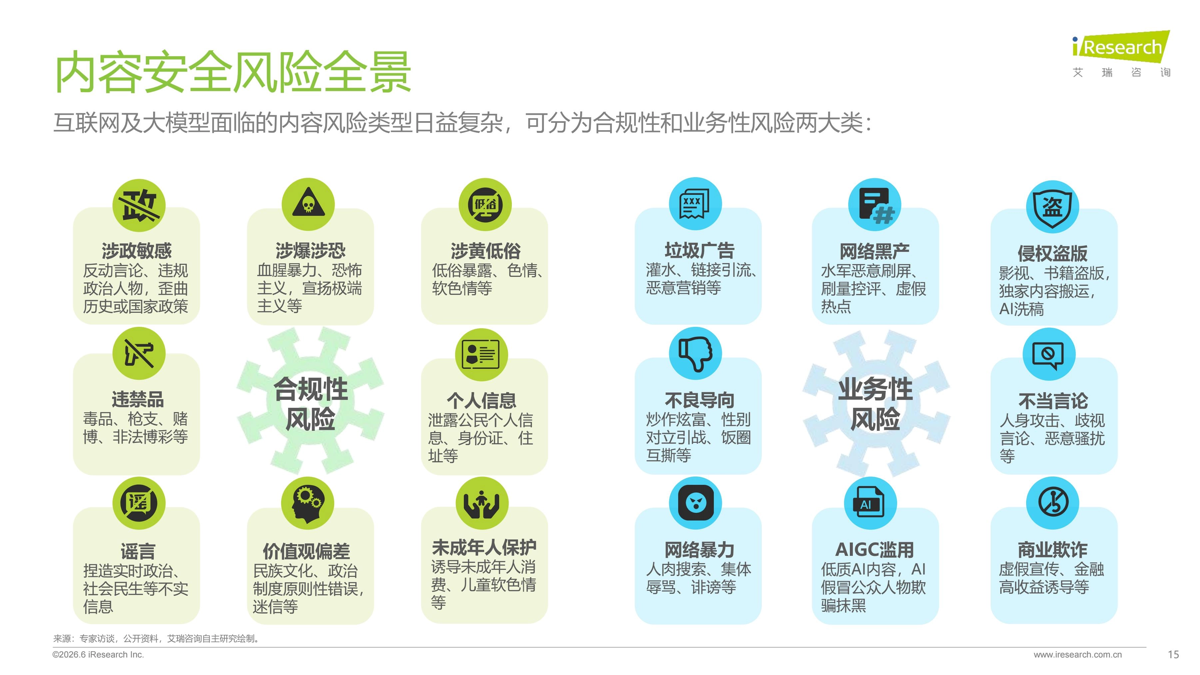
- Market Size Forecast (Third-Party Content Risk Control Market Based on Large Model Technology)
- 2023: 1.18 billion yuan
- 2024: 1.73 billion yuan
- 2025: 2.48 billion yuan
- 2026 (Forecast): 3.42 billion yuan
- 2027 (Forecast): 4.62 billion yuan
- 2028 (Forecast): 6.10 billion yuan
- 2029 (Forecast): 7.81 billion yuan
- 2030 (forecast): 9.37 billion yuan
- The forecast compound annual growth rate exceeds 30%.
Industry Chain and Industry Ecosystem
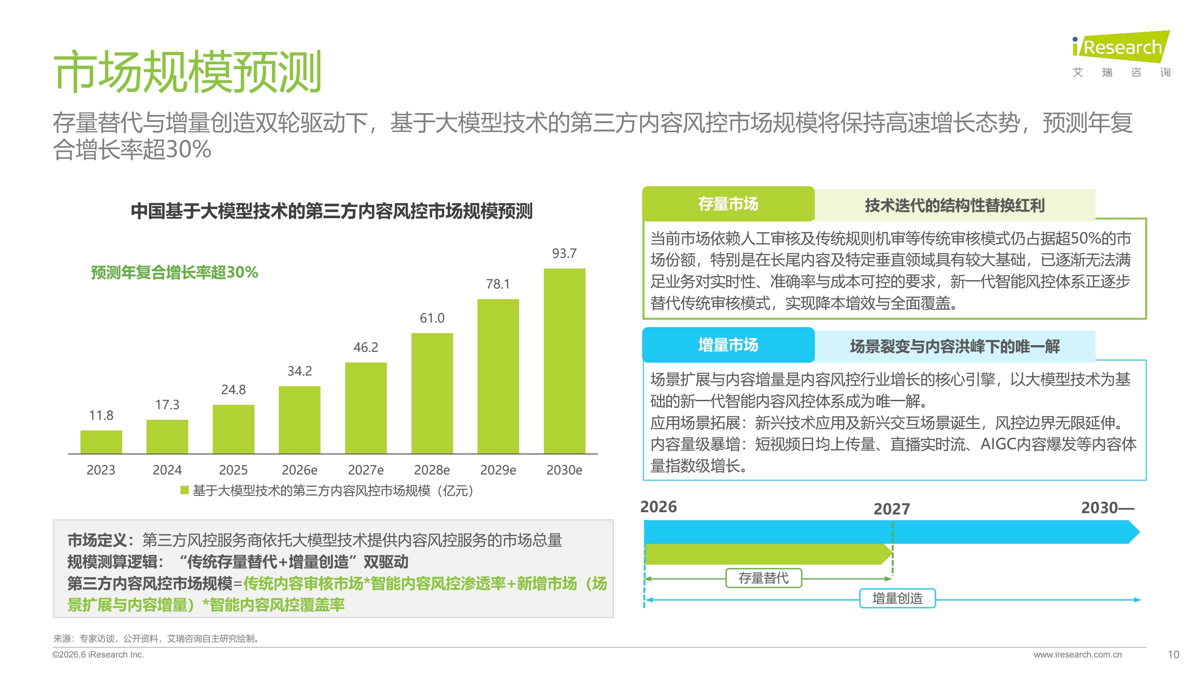
- Three-tier Industry Chain Structure
- Upstream: Foundation layer. Provides foundational support such as computing power, algorithms, and data resources. Representative vendors include foundational technology providers such as Alibaba Cloud, Tencent Cloud, Huawei Cloud, Baidu AI Cloud, and China Telecom Cloud; data resource parties such as the Cyberspace Administration of China, the Chinese Internet Corpus Resource Platform, and Speechocean.
- Midstream: Core layer. Provides content risk control products and services, divided into three categories:
- Professional risk control service providers: NetEase Smart Enterprise · Yidun, Ishumei, RealAI, BotSmart, Qingqiong.
- Comprehensive cloud vendors: Alibaba Cloud AI Security Guardrails, Tencent Cloud Tianyu, Baidu AI Cloud Content Review Platform, Huawei Cloud Content Moderation.
- Traditional cybersecurity vendors: 360, NSFOCUS, Qi An Xin, Topsec.
- Downstream: Application layer. Content risk control demand-side parties, including internet platforms (Xiaohongshu, Zhihu, Sohu, Douyu, TT Voice) and large model applications (Kimi, DeepSeek, MiniMax).
- Business Forms and Payment Models
- Service model: Risk control as a service (SaaS), covering multimodal, full-scenario content risk control; leading service providers offer full-stack risk control services from content to business.
- Payment methods: SaaS subscription (annual fees by account/traffic, payment by review call volume such as Tokens); customized deployment (project buyout with maintenance fees).
- Derived businesses: Enterprise content security training, compliance certification consulting, large model red team-blue team confrontation drills, large model filing, brand public opinion monitoring.
Overview of Content Security Risks
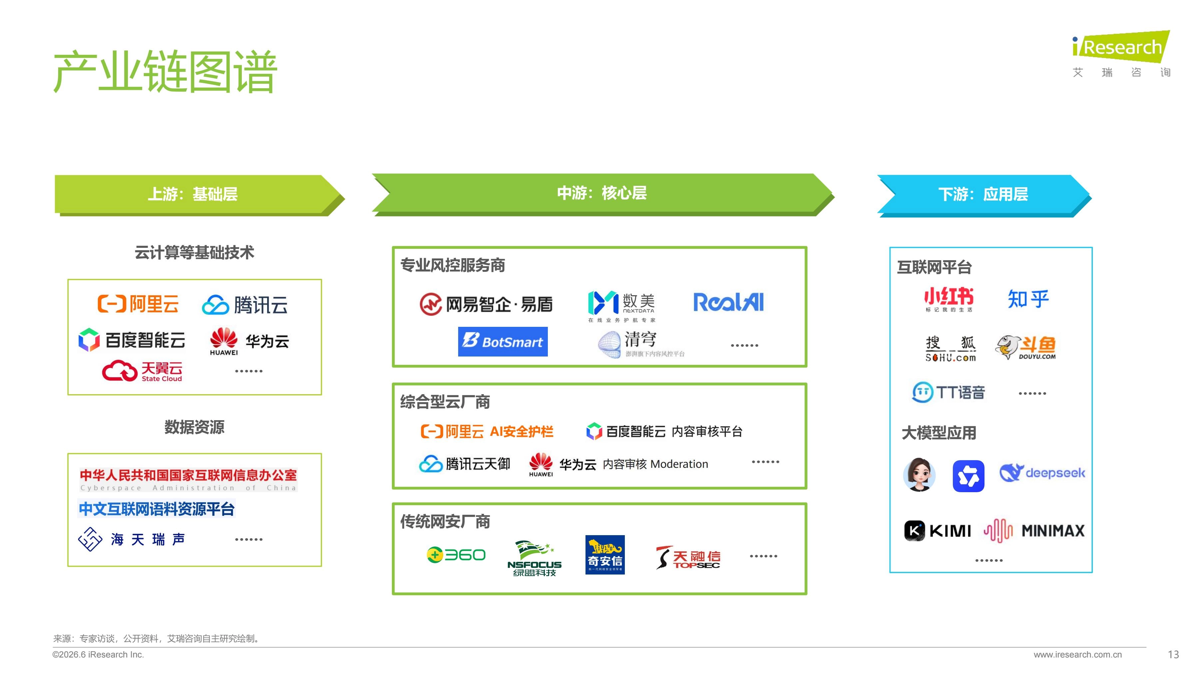
The content risks faced by the internet and large models are divided into two major categories: compliance risks and business risks.
- Compliance risks (8 categories)
- Politically sensitive: reactionary speech, illegal political figures, distortion of history or national policies
- Explosives and terrorism-related: bloody violence, terrorism, promotion of extremism
- Pornographic and vulgar: vulgar exposure, pornography, soft pornography, etc.
- Contraband: drugs, firearms, gambling, illegal betting, etc.
- Personal information: disclosure of citizens' personal information, ID cards, addresses, etc.
- Rumors: fabrication of false information on real-time politics, social livelihood, etc.
- Value deviation: principled errors regarding ethnic culture and political systems, superstition, etc.
- Protection of minors: inducing minors to spend, child soft pornography, etc.
- Business risks (8 categories)
- Spam advertising: flooding, link diversion, malicious marketing, etc.
- Internet black industry: malicious flooding by paid posters, fake engagement and comment control, fake trending topics
- Infringement and piracy: piracy of films, television, and books,搬运 of exclusive content, AI rewriting
- Harmful guidance: hyping wealth flaunting, gender antagonism and provocation, fan circle infighting, etc.
- Inappropriate Speech: Personal attacks, discriminatory remarks, malicious harassment, etc.
- Cyberbullying: Doxxing, mass abuse, defamation, etc.
- AIGC Abuse: Low-quality AI content, AI impersonation of public figures for deception and smearing
- Commercial Fraud: False advertising, inducement with promises of high financial returns, etc.
Core Requirements for Content Risk Control in the AIGC Era
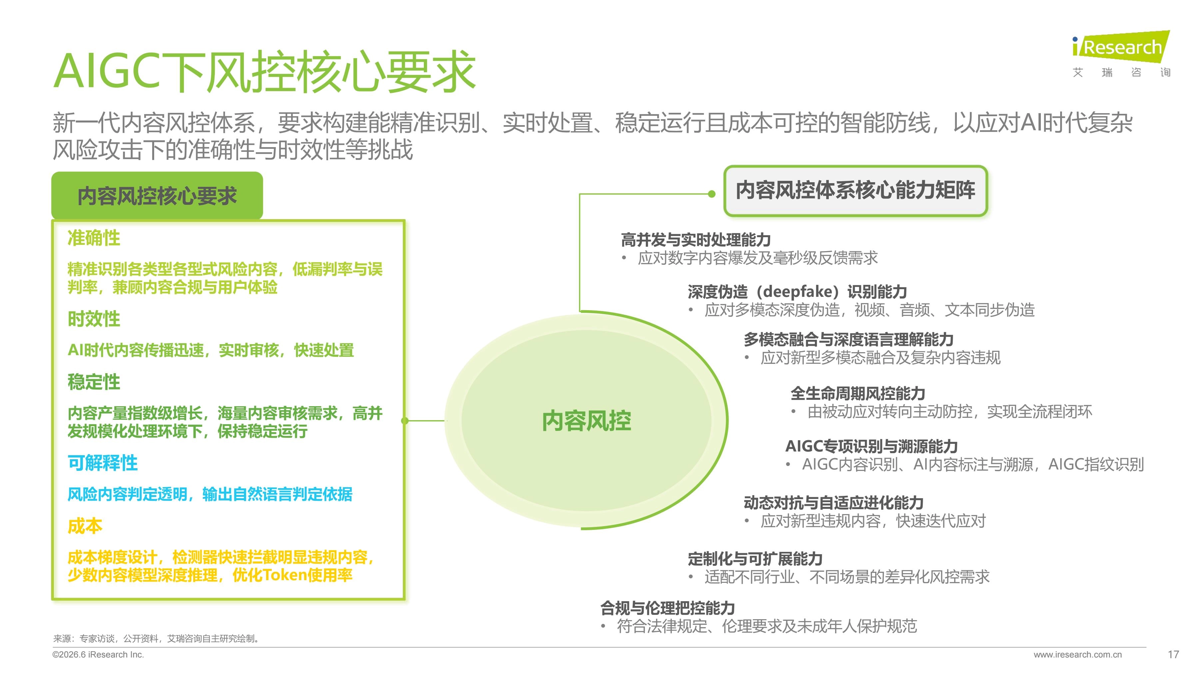
- Six Core Dimensions of the New-Generation Content Risk Control System
- Accuracy: Precisely identify various types and forms of risky content, with low miss and false-positive rates, balancing content compliance and user experience.
- Timeliness: In the AI era, content spreads rapidly, requiring real-time review and rapid handling.
- Stability: With content volume growing exponentially, maintain stable operation under high-concurrency, large-scale processing for massive review demands.
- Explainability: Transparent determination of risky content, outputting the basis for the determination in natural language.
- Cost: Tiered cost design; detectors quickly intercept clearly violating content, while a small number of content items undergo in-depth model reasoning, optimizing Token usage.
- Core Capability Matrix of the Content Risk Control System (8 Major Capabilities)
- High-Concurrency and Real-Time Processing Capability: Address the explosion of digital content and millisecond-level feedback needs.
- Deepfake Identification Capability: Address multimodal deepfakes, with synchronized forgery of video, audio, and text.
- Multimodal Fusion and Deep Language Understanding Capability: Address emerging multimodal fusion and complex content violations.
- Full Lifecycle Risk Control Capability: Shift from passive response to proactive prevention and control, achieving a full-process closed loop.
- AIGC-Specific Identification and Traceability Capability: AIGC content identification, AI content labeling and traceability, AIGC fingerprint identification.
- Dynamic Adversarial and Adaptive Evolution Capability: Respond to new types of violating content with rapid iterative response.
- Customization and Scalability Capability: Adapt to differentiated risk control needs across industries and scenarios.
- Compliance and Ethics Control Capability: Comply with legal regulations, ethical requirements, and minor protection standards.
Industry Competitive Landscape and Vendor Practices
- 2025 China Large Model Content Risk Control Market Competitive Landscape
- NetEase Zhigi - Yidun: Holds approximately 43.7% market share, ranking first among large model content risk control service providers. Core advantages include a complete product system ("endogenous security + fence protection" full chain, multimodal); authoritative compliance endorsement (core drafting unit of the national standard "Basic Safety Requirements for Generative Artificial Intelligence Services"); and sufficient market validation (serving 100+ AIGC customers, covering leading customers such as Kimi and MiniMax).
- Other Service Providers: Account for approximately 56.3% market share, including professional risk control vendors such as Shumei, RealAI, BotSmart, and Qingqiong, as well as traditional cybersecurity vendors such as 360 and QiAnXin.
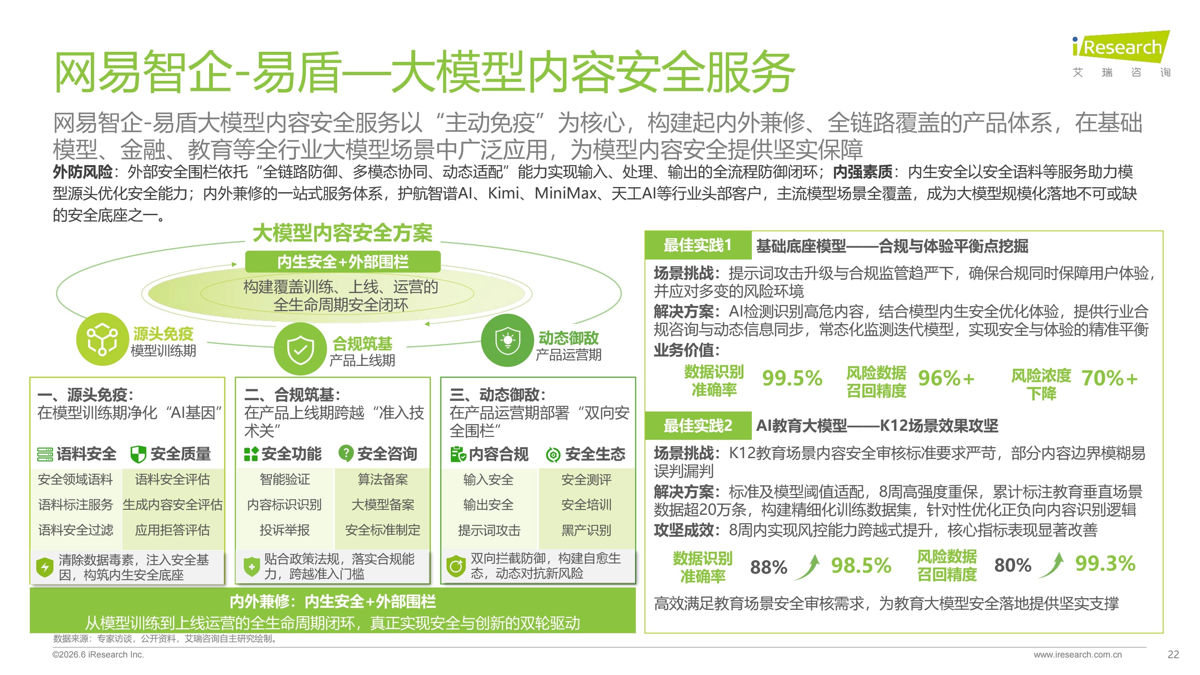
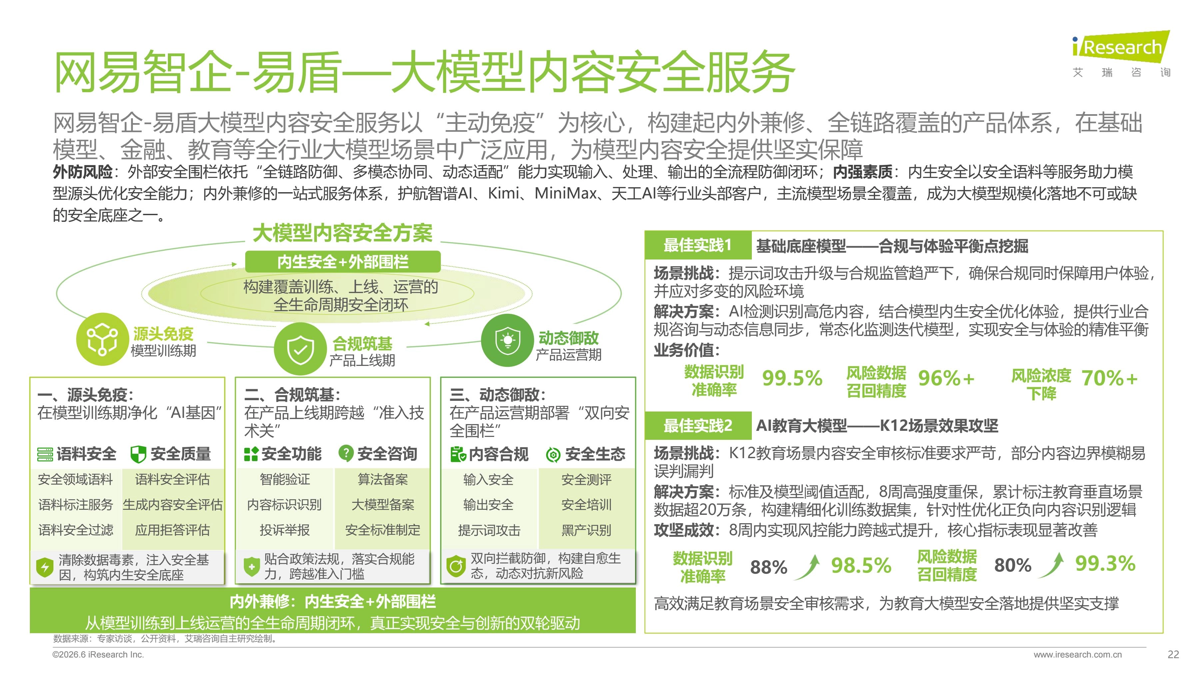
- NetEase Zhigi - Yidun Best Practices
- Practice 1: Foundation Base Model
- Core Challenges: Prompt attacks are escalating and compliance regulation is tightening; it is necessary to balance compliance and experience.
- Solution: AI detection identifies high-risk content, combines with model intrinsic security to optimize experience, provides industry compliance consulting and dynamic information synchronization, and continuously monitors and iterates the model.
- Key Results: Risk concentration decreased by more than 70%, and data recognition accuracy reached over 96%.
- Practice 2: AI Education Large Model (K12 Scenario)
- Core Challenges: The content safety review standards in K12 education scenarios are stringent, and some content boundaries are blurred, making misjudgments and omissions easy.
- Solution: Standards and model thresholds were adapted, 8 weeks of high-intensity major support were provided, more than 200,000 pieces of education vertical scenario data were annotated in total, a refined training dataset was built, and the positive and negative content recognition logic was optimized in a targeted manner.
- Key Results: Within 8 weeks, risk control capabilities achieved leapfrog improvement, risk data recall precision increased from 80% to 88%, and data recognition accuracy reached 98.5%.
- Practice 1: Foundation Base Model
- 360 Large Model Guardian
- Core Concept: With "governing models with models" as the core, it adopts external security + platform-native security strategies.
- Product Matrix:
- Large Model Guardian Computing Power Host Security System: AI asset discovery, intrusion detection, MCP detection.
- Large Model Guardian Protection System: Content security guardrails, security management functions, content security assessment.
- Large Model Hallucination Detection and Mitigation System: Search enhancement, knowledge injection, intent understanding.
- Protection Stages: Pre-event (content assessment · risk shifted forward), in-event (multiple detection · precise protection), post-event (strategy tuning · capability iteration).
Application Scenarios and Future Trends
- Core Scenarios Continue to Deepen
- General Internet Scenarios: General internet scenarios such as social networking, short videos, live streaming, e-commerce, and gaming continue to deepen.
- AIGC and Large Models: Full lifecycle governance of model content has become an emerging core scenario, with application expansion in Agent logic, permissions, and more.
- Intellectual Property and Copyright Protection: Monitoring of infringing videos, pirated text, plagiarized images, faces and voiceprints, and protection of various types of content property and copyright.
- Minor Protection: Refined content, shielding in specific scenarios, anti-addiction and inducement identification.
- Vertical Fields and Emerging Scenarios Accelerate Expansion
- Government and Enterprise: Government affairs content compliance, sensitive information filtering.
- Finance: Financial fraud identification, false advertising interception, compliance review.
- Healthcare: Authenticity review of medical information, identification of false medical advertising.
- Advertising: Advertising law compliance verification, intent insight and value orientation.
- Academic Education: Education content safety, academic integrity, refined review of K12 scenarios.
- Publishing: Publication content compliance, copyright protection.
- Short Dramas and Comic DramasScript content review, visual compliance, value orientation.
- Enterprise Going GlobalCross-border compliance: respond to complex international compliance environments, achieve multilingual and cross-cultural compliance, and platform rule adaptation.
- AIGC New Media OperationsAI media operations content complies with advertising law, with compliance verification, intent insight, and value orientation.
- Virtual Human/Digital Human InteractionReal-time control of interactive content, mandatory identity labeling for digital humans, portrait rights and voiceprint protection.
- Virtual Reality and MetaverseDigital asset and 3D space security, virtual environment compliance, deep interaction monitoring.
Core Conclusions of the Report
- Rapid Market Growth: The third-party content risk control market based on large model technology has a compound annual growth rate of over 30%, and is expected to reach 9.37 billion yuan by 2030.
- Upgrade of Technical Paradigm: A leap from traditional manual/rule-based review to an intelligent risk control system driven by "AI-native + large models".
- AIGC Becomes the Core Battleground: Large model input and output security, hallucination detection, prompt attack defense, and AIGC traceability have become the industry's technological high ground.
- Full Lifecycle Closed Loop: Content risk control covers the entire cycle of model training, product launch, and operations, achieving "source immunity - compliance foundation - dynamic defense".
- Infinitely Expanding Scenario Boundaries: Penetration from general internet into all scenarios including finance, healthcare, education, going global, virtual humans, and the metaverse.
- Head Concentration Effect: NetEase Zhigi-Yidun leads the large model content risk control track with a 43.7% market share, with a significant benchmark effect.
Scan the QR code to follow the official account and reply with the keyword:20260618, to receive the PDF report for free