
《2026 Agent Talent Report》 is a report released by Zhiwang Technology Mozhi Space in June 2026. The full text is a 35-page PPT that systematically reviews the current state of the agent industry, talent market supply and demand, job system mapping, and training pathways. The report is based on spring 2026 recruitment data from platforms such as Zhaopin, Liepin, and Maimai, as well as industry forecasts from institutions such as MarketsandMarkets and the China Commercial Industry Research Institute, providing decision-making reference for enterprises and individuals entering the agent track.

Scan the QR code to follow the official account, and reply with the keyword:20260617, to receive the PDF report for free
Current State and Trends of the Agent Industry
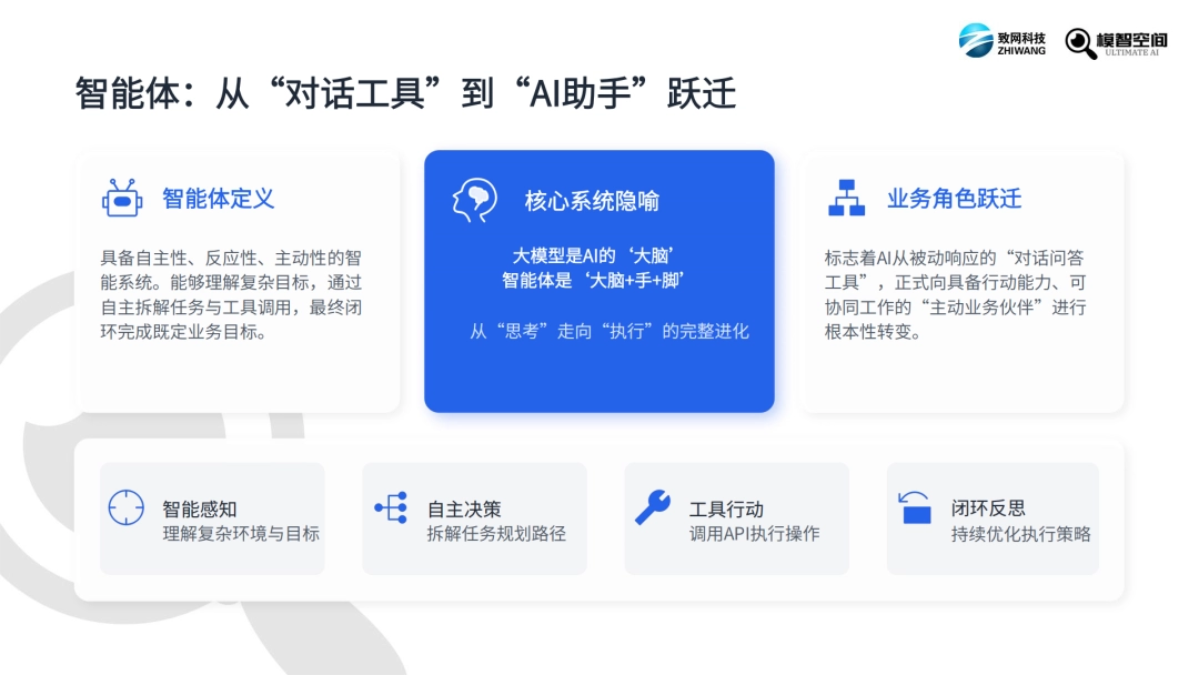
- Definition and Core Metaphor of Agents: An agent is an intelligent system with autonomy, reactivity, and proactiveness, capable of understanding complex goals and completing business objectives through autonomous task decomposition and a closed loop of tool invocation. The core metaphor is "large models are the brain of AI, and agents are the brain + hands + feet," marking AI's leap from a passive "conversational tool" to an active "business partner."
- Global and China Market Size
- Global Market: Expected to reach USD 47.1 billion by 2030, with a compound annual growth rate of 44.8%; by 2027, 50% of generative AI enterprises are expected to deploy agents.
- China Market: The market size of industry-grade AI agents was approximately RMB 5.7 billion in 2025, will exceed RMB 10 billion in 2026, and is expected to reach RMB 45.8 billion in 2029.
- Three-Layer Collaboration Across the Industry Chain: China has already formed a complete ecosystem structure of "basic technology and infrastructure layer—model and development platform layer—application and service layer."
Agent Talent Market Insights
- 2026, the First Year of Explosion and Surging Demand
- Gartner predicts that by the end of 2026, 40% of enterprise applications will integrate task-based agents.
- OpenClaw surpassed 300,000 stars on GitHub within more than two months of launch, setting a historical record for open-source software.
- In early 2026, the number of newly posted AI-related positions surged 12-fold year-on-year, and the number of agent-related job postings grew by as much as 455% year-on-year.
- Industry and City Distribution of Talent Demand
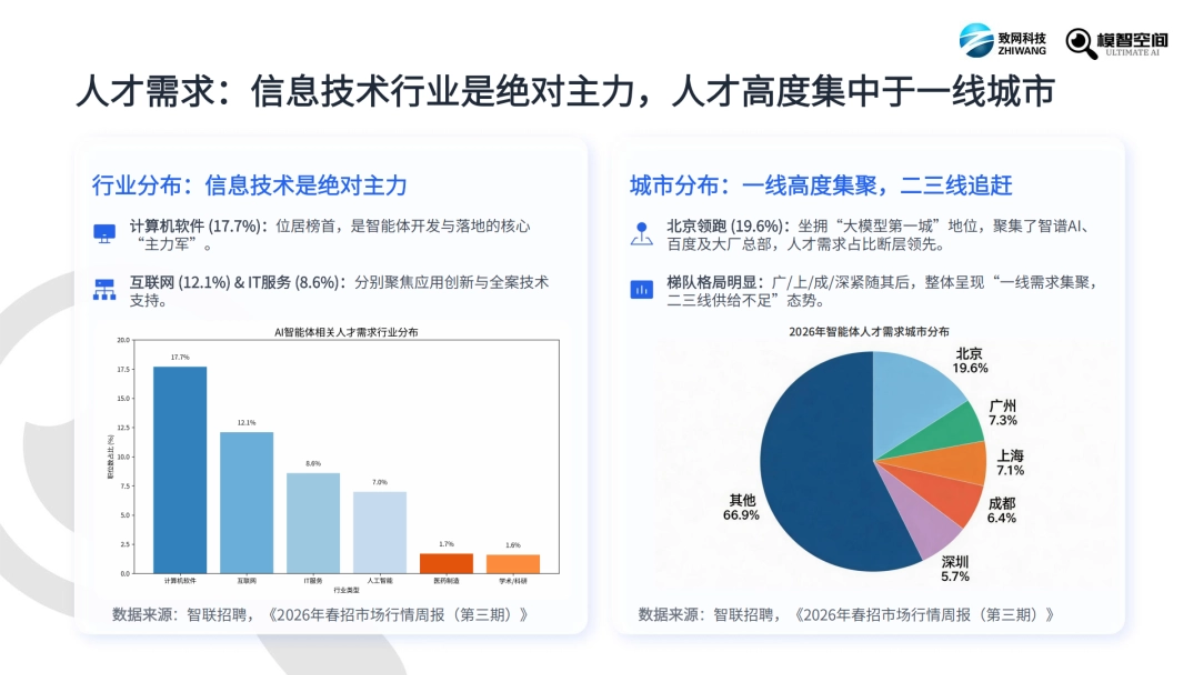
- Industry Distribution: Information technology is the absolute main force, with computer software (17.7%), internet (12.1%), and IT services (8.6%) ranking in the top three.
- City Distribution: Beijing leads by a wide margin at 19.6%, followed by Guangzhou (7.3%), Shanghai (7.1%), Chengdu (6.4%), and Shenzhen (5.7%), overall showing a trend of "concentrated demand in first-tier cities and insufficient supply in second- and third-tier cities."
- Salary Levels and Premiums
- AI scientists earn an average monthly salary of RMB 132,000, senior agent architects earn RMB 50,000-80,000 per month, while traditional AI practitioners earn only RMB 15,000-30,000 per month, showing a significant salary gap.
- 59.6% of agent positions offer monthly salaries above 25K, and Beijing has the highest proportion of positions with monthly salaries above 40K.
- Divergence in Enterprise Talent Strategies
- Big Tech Strategy: Proactive moves and independent research and development, using brand and high salaries to compete for top talent, and building in-house research institutes to construct technological moats.
- SME Strategy: Demand-oriented and win-win cooperation, by purchasing AaaS platform services or leveraging external ecosystems to skip underlying research and directly solve business problems.
- Supply-Demand Imbalance and Structural Contradictions
- The talent supply-demand ratio in the AI field is only 0.97, meaning there are only 97 job seekers for every 100 positions.
- The AI penetration rate of newly posted positions soared from 2.29% in January-February 2025 to 26.23% in the same period of 2026.
- The trend of "de-juniorization" in corporate recruitment is significant: 34.39% of newly posted positions require AI capabilities, positions requiring more than 3 years of experience account for over 70%, and positions requiring less than 1 year of experience have shrunk by 20%.
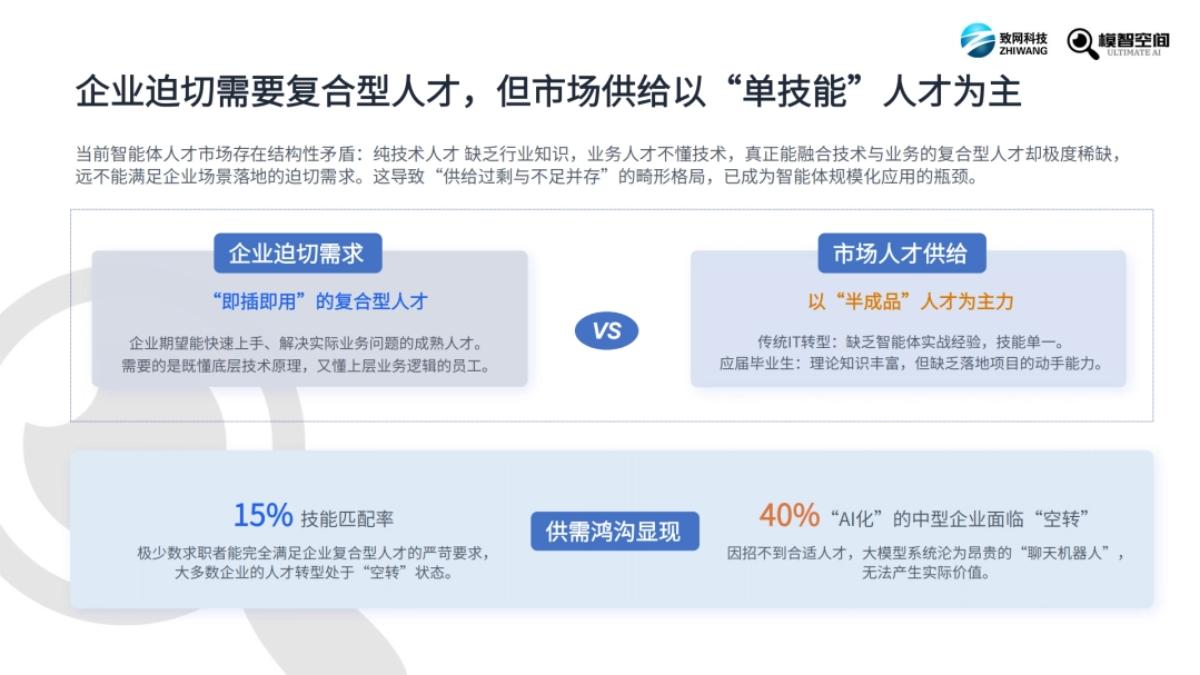
- Composite talent is extremely scarce; only 15% of job seekers can fully meet corporate requirements, and 40% of mid-sized enterprises have large model systems "idling" because they cannot recruit suitable talent.
Agent Job System
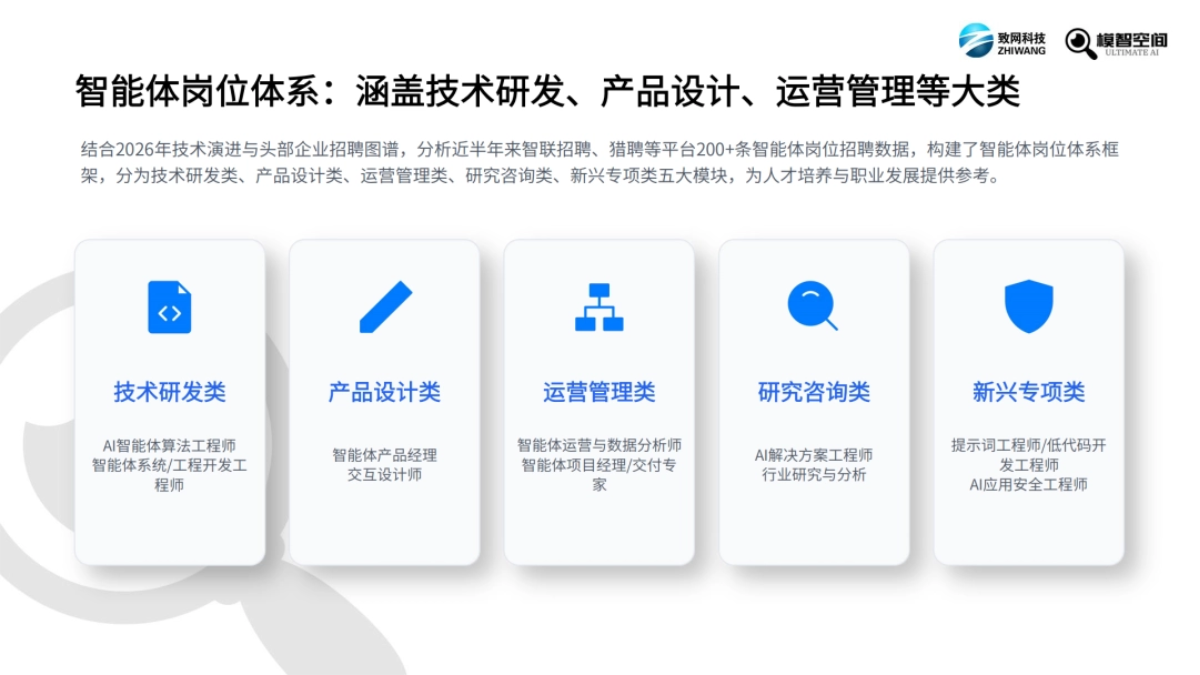
- Five Major Job Modules
- Technology R&D: AI agent algorithm engineer, system/engineering development engineer.
- Product Design: agent product manager, interaction designer.
- Operations Management: agent operations and data analyst, project manager/delivery expert.
- Research & Consulting: AI solutions engineer, industry research and analyst.
- Emerging Specialized Roles:prompt engineer/low-code development engineer, AI application security engineer.
- Distribution of Core Job Demand
- Algorithm engineers account for 25.9%, the highest demand.
- AI product managers account for 9.4%, with fast-growing demand.
- Basic technical talent such as Java (6.7%) and Python (6.1%) accounts for 62%, forming the technical foundation.
- Architects account for only 2.7%, and such talent is extremely scarce.
- High-Frequency Recruitment Terms and Capability Requirements: Industry requirements have upgraded from understanding models to understanding Agentic Workflow. On the development framework side, attention is paid to LangChain, LangGraph, AutoGen, Dify, and Coze; on the core module capability side, attention is paid to task planning (Planning), memory management (Memory), tool invocation (Function Calling/MCP), and retrieval-augmented generation (RAG).
- Composite Emerging Positions
- FDE (Field Deployment Engineer): recruitment volume reached 5,330 postings in April 2026, a year-on-year increase of 729%, with an annual salary of USD 170,000-200,000, requiring both AI technical architecture knowledge and deep industry business understanding.
- Integrated positions such as ITBP (IT Business Partner), AI evangelist, and Chief AI Officer are rapidly emerging.
Talent Capability Model and Career Paths
- Three Types of New Talent: McKinsey proposes: M-shaped general managers (building hybrid workflows), T-shaped deep experts (deep knowledge in specific fields), and AI-empowered frontline workers (social-emotional skills + basic AI literacy).
- Three Career Development Paths
- Technical Track: Backend/Algorithm → Agent Engineer → Agent Technology Expert → Architecture Lead/Chief Scientist.
- Product/Business Track: Assistant/Operations → AI Product Manager → Agent Solutions Expert → AI Product Director.
- Cross Track: Full-Stack Engineer → AI Consulting Architect → Industry Delivery Lead/Technical Partner.
Talent Development and Future Outlook
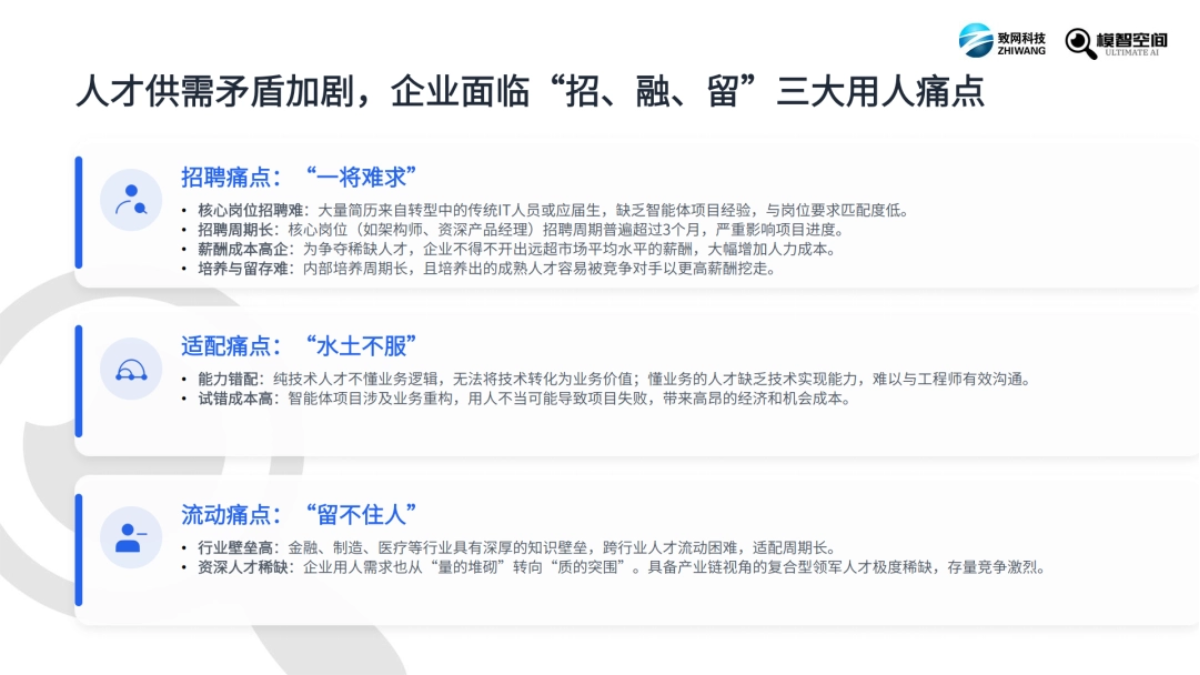
- Three Major Pain Points in Corporate Employment
- Recruitment Pain Point: "A capable general is hard to find"; recruitment cycles for core positions generally exceed 3 months, and compensation costs remain high.
- Adaptation Pain Point: "Poor fit"; purely technical talent does not understand the business, while business talent lacks technical implementation capabilities.
- Mobility Pain Point: "Unable to retain people"; cross-industry talent mobility is difficult, and composite leading talent with an industry chain perspective is extremely scarce.
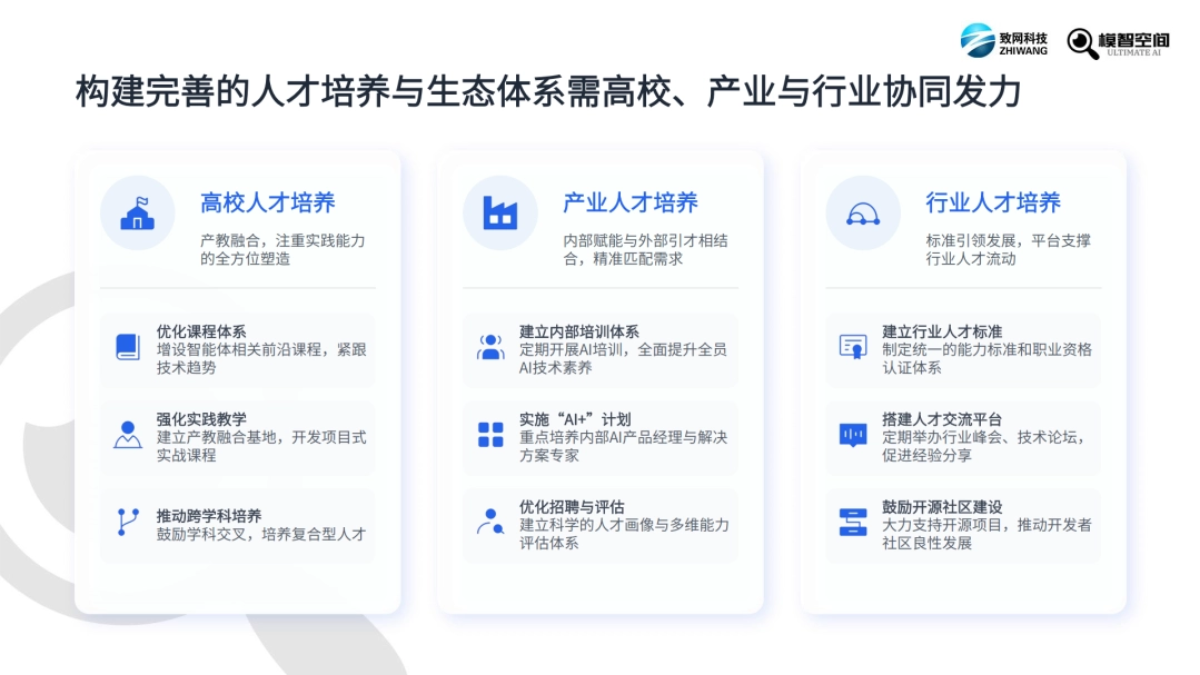
- Collaborative Training by Universities, Industry, and Sector
- Higher education sector: More than 700 undergraduate universities and over 900 higher vocational colleges nationwide have already established AI-related majors, and there is a need to optimize the curriculum system, strengthen industry-education integration training bases, and promote interdisciplinary training.
- Enterprise sector: Implement a company-wide AI literacy "immersion" program, design a three-stage progression path of "newcomer-proficient-expert," and promote a school-enterprise joint project system in which "enterprises pose the problems, teachers and students solve them, and results are implemented."
- Industry sector: Establish a unified competency standard and professional qualification certification system, build a talent exchange platform, and encourage the development of open-source communities.
- Personal growth suggestions
- Non-technical backgrounds: You can start by quickly building prototypes through low-code platforms such as Dify and Coze.
- Technical practitioners: Become proficient in LangChain/AutoGen, master core modules such as task planning and RAG, participate in authoritative evaluation benchmarks such as GAIA and AgentBench to validate capabilities, and maintain highly active projects on GitHub.
- Core transformation: Advance from "hard-coded logic" to "guided logic," deepen vertical industry know-how, and develop "human-machine collaboration" as a first reaction.
- Future trends outlook
- Technology: Multi-agent collaboration will become mainstream, and low-code/no-code platforms will promote the democratization of technology.
- Talent: Demand for top algorithm talent and a large number of application-oriented talent will coexist, and diversified training paths will accelerate their formation.
- Industry: Shift from "+AI" to "AI+," and business models will gradually upgrade toward "pay-for-performance."
- Ecosystem: Open-source projects will continue to stimulate innovation vitality, and industry alliances will promote the establishment of industry standards and ethical norms.
Scan the QR code to follow the official account and reply with the keyword:20260617, to receive the PDF report for free